Repair Teens
Repair Teens was a collaboration between the Techniekacademie, an initiative of VIVES Hogeschool, and the project partners BEMAS vzw, POM, Repair&Share (known from the Repair Cafés) and a group of industrial partners. Repair Teens wanted to get the target group of 12-14 year olds interested in maintenance and STEM and show them how maintenance itself could have a positive impact on and contribute to a more sustainable world.
Repair Teens not only taught STEM knowledge and skills, but through this concept also informal 21st century skills such as entrepreneurship, digital skills, cooperation, problem solving, and care for environment and nature. The Repair Teens project was realised with the active support of the Flemish Innovation and Enterprise Agency.
Under supervision, young people got to work themselves to solve real business and social challenges. STEM knowledge and competences were the key to this. This should have inspired them to see STEM as a positive and obvious choice in their further studies and careers. With its focus on “maintenance & repair”, Repair Teens wanted to enthuse young people in particular about the importance of maintenance & repair as part of the circular economy and to help young people move into maintenance professions in industrial companies.
What did Repair Teens want to accomplish?
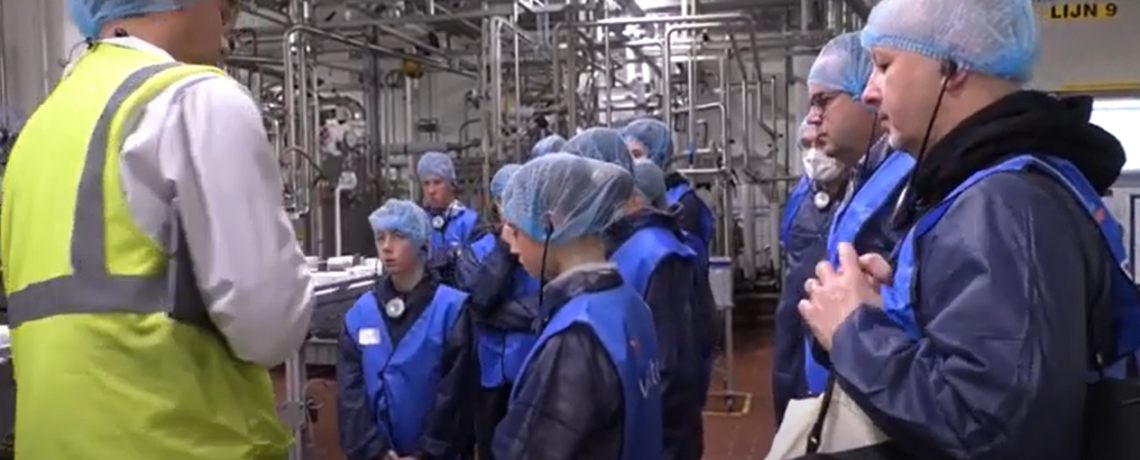
Repair Teens developed, together with young people and companies, a new extracurricular STEM track, entirely (and for the first time) dedicated to maintenance & repair. The programme consisted of two parts: open introductory sessions at companies from various sectors and at Repair Cafés all over Flanders. During these sessions, young people themselves were allowed to solve real life cases of companies and societal challenges. They also learned about the importance and impact of the circular economy, and how they themselves could contribute to it. They also got the chance to take a behind-the-scenes tour of the company or work as a fixer in the Repair Café.
Young people who had acquired a taste for it could sign up for part two: a course of twelve consecutive sessions (lasting one semester), in which fixed teams of young people solved a maintenance or repair challenge under supervision. An innovative app for digital instructions was also used.
Four industrial companies committed to the project through BEMAS. They each came from a different province and sector: Evonik, Norbord, Vandemoortele, Volvo Cars Ghent. A fifth BEMAS member, Manual.to, would provide a digital tool that gave the young people the right instructions on how to carry out maintenance and how to create new instructions themselves. In a next phase, other interested companies could sign up as well.

Focus on Maintenance and repair
In consultation with BEMAS and Repair&Share, it was decided to zoom in on maintenance and repair with Repair Teens. Maintenance, repair and life extension were at the heart of the internationally recognised circular model of the Ellen MacArthur Foundation. Maintenance was carried out in the use phase of the product life cycle of a device or installation. It was the most efficient way to make the best use of the materials used and the energy invested in them. Moreover, maintenance ensured personal safety, the prevention of contamination and optimal energy consumption. In addition to maintenance, repair also helped ensure that consumer goods remained in use for as long as possible. The chosen theme of maintenance & repair therefore fitted seamlessly with the theme of circular economy.
Repair Teens wanted to use this theme to turn around the negative reporting that young people were confronted with on a daily basis, and to show that young people themselves had the answer to social challenges such as climate change. The starting point was today's throw-away culture, in which young people were protagonists. In line with the concept of the Repair Cafés, Repair Teens wanted to get young people to maintain and repair instead of thoughtlessly throwing away defective products and buying new ones.
Origin of RepairTeens
In 2019, the VIVES Engineering Academy was recognised as a STEM partnership. The Junior Engineering Academy gives children aged 8 to 10 a taste of engineering and STEM, while children aged 10 to 12 can experiment in the Teen Engineering Academy. With the positive feedback from the young participants and their surroundings, the question also arose: What happens when primary school is over? It is important that young people in secondary education, even if they have not (yet) chosen a STEM course, (continue to) see STEM as an attractive and particularly relevant choice. The Techniekacademie therefore set up a first campaign with the STEM camps for the target group of 12- to 14-year-olds.
With this new STEM trajectory Repair Teens, the partnership now wants to develop a structural operation for this target group. Repair Teens aims not only to offer a follow-up to the current participants of the Technical Academy, but also to pick up young people who have not yet been reached. Repair Teens wants to create the same drive and enthusiasm as in the current Technical Academy, but the approach and recruitment will have to change. From secondary school onwards, children decide more for themselves, have an even wider range of leisure activities to choose from or choose to stay at home (with the tablet or console), etc. The Technique Academy starts from the beginning. The Techniekacademie bases the content of the sessions on the children's world. Repair Teens makes the effort even more challenging: Repair Teens wants to trigger young people not only to discover their own interests and skills, but also to create solutions for the world around them.
First phase with 5 BEMAS member companies
Five companies from various sectors and provinces committed themselves as business partners in collaboration with BEMAS. These were Evonik, Norbord, Vandemoortele, Volvo Cars Gent and Manual.to. The manufacturing companies were co-creators of the didactic set-ups for the introductory sessions, collaborated both organisationally and content-wise on a pilot introductory session of Repair Teens in their company (including a company tour), evaluated the pilot introductory sessions and hosted one or more introductory sessions during the further roll-out of the project.
Manual.to provided a digital component throughout the sessions with its instructional software. All business partners helped publicise the concept and the results of Repair Teens through their own channels and partners. Finally, they actively participated in the steering committee and supported the youth advisory board. For the business partners, participating in Repair Teens meant that they could introduce themselves in a very positive and direct way to young people who could become their employees of the future, they could highlight their CSR goals and operation, and got broad visibility for their company and the sector, etc.
In a first phase, only the partners mentioned above were involved, but in a second phase other companies were able to sign up. Interested companies could fill in the form if they were interested in opening their doors to young people. They then received more information.
Repair Teens was realised with active support from the Flemish Agency for Innovation and Entrepreneurship (Vlaams Agentschap Innoveren en Ondernemen).
Project lead
VIVES coordinated Repair Teens. This included supporting the steering committee and youth advisory board, monitoring the content of the concept, organising and/or supporting the individual introductory and training sessions, organising and supporting communication, building a community around Repair Teens, preparing a sustainable roll-out of Repair Teens, knowledge sharing and knowledge assurance. In addition, VIVES as an educational partner within Repair Teens provided support for the didactic concept, coaching sessions, STEM competences, etc. VIVES could rely on its own training programmes and expertise centres, such as the Bachelor's degree in secondary education, the Bachelor's degree programmes in industrial sciences & technology and biotechnology, and the expertise centres Education Innovation and Smart Technologies.
VIVES was the founder and leader of the Techniekacademie (since 2014), and as such had extensive experience in developing a pathway such as Repair Teens, albeit for the target group of 8- to 12-year-olds. In addition to the Technique Academy, VIVES had several STEM initiatives underway, both in terms of applied research and in terms of education and awareness-raising. VIVES was also part of STEM learning networks and partnerships. VIVES contributed this expertise and these networks to the creation of Repair Teens. For VIVES, Repair Teens was an important link in reaching and enthusing children and young people about STEM.
Many of VIVES' STEM activities are currently aimed at pre-schoolers, primary school pupils and third-year secondary school pupils. With the target group of 12 to 14 year olds in Repair Teens, VIVES can develop a stronger continuum and take young people from kindergarten to higher education or the job market and support them in their STEM interests. The specific theme of maintenance and repair also provides VIVES with an extra approach to fulfilling its mission of providing social services: it offers VIVES the chance to contribute in the long term to the filling of bottleneck professions such as maintenance technicians in regional companies, to help put the importance of the circular economy on the map and to provide concrete solutions, and to support and inspire citizens' initiatives around the circular economy with the input of young people and other stakeholders such as companies. Via Repair Teens, VIVES also gets the chance to broaden its network around maintenance & repair with business partners and a platform such as BEMAS, and with local authorities and citizens' initiatives. Finally, the cooperation with Thomas More WiWeTeR and PXL STEM Academy offers the opportunity to thoroughly test the Repair Teens concept and VIVES will be given the opportunity to test and help roll out their concepts.
Supported by


BEMAS
BEMAS is a cross-sector non-profit professional organisation on the subject of maintenance and asset management (life cycle management). Some 585 companies are currently members of BEMAS. About half of them are asset-intensive organisations such as production companies from all sectors (chemicals, food, metals, etc.) and operators of infrastructure (such as utilities or public transport). A quarter of the members are maintenance service companies and the remaining quarter consists of other suppliers in maintenance (supplies, consultancy, ICT or training and education). 80% of the members are located in Flanders. BEMAS brings this substantively and geographically diversified network into Repair Teens, and secured the commitment of the five business partners. In the framework of Repair Teens, BEMAS acts as a liaison between the industrial partners and the Techniekacademie and other participating STEM academies. BEMAS helps to recruit, motivate and supervise industrial host companies and takes care of evaluation moments with the companies. BEMAS also takes an active part in the didactic development of the introduction and training sessions, and is jointly responsible for supporting the sessions at industrial partners and the Repair Cafés. BEMAS also brings in knowledge and expertise on maintenance & repair, the core theme of Repair Teens.
BEMAS has a great deal of knowledge about maintenance & repair itself and can also call on the knowledge and expertise of the members of the Board of Directors, the network of trainers with whom BEMAS organises training courses and the member network of more than 800 maintenance professionals active in just about all sectors. In the field of circular maintenance, BEMAS is currently a partner in the Interreg project Circular Maintenance (see circulair onderhoud.eu). BEMAS will contribute learning points on maintenance and circularity to Repair Teens. Finally, BEMAS has extensive in-house expertise on competences in maintenance; based on this, BEMAS can help shape the didactic and content-based elaboration of the various sessions in Repair Teens. BEMAS is also involved in the development and publication of web content around the design and results of Repair Teens. BEMAS also provides targeted communication to BEMAS members and partners and to the technical trade press. BEMAS shares the project experiences and results with other business organisations in Flanders and other maintenance associations in Europe. Finally, BEMAS actively participates in the steering committee and the youth advisory board (BEMAS helps to recruit young people from the business partners and guide them).
For BEMAS, Repair Teens is an important step towards achieving its objective of encouraging young people to choose an education and profession in maintenance. It is not always easy to get the target group of 12- to 14-year-olds enthusiastic about this theme. By joining forces in Repair Teens, and making maintenance & repair fit into the world of individual young people and their social commitment, BEMAS wants to get this target group excited about the business aspects of maintenance & repair. In this way, BEMAS is helping to bring about an influx of young people into its member companies and the sector. Repair Teens also offers BEMAS the opportunity to strengthen its network towards educational actors, civic initiatives, youth organisations and local authorities and to promote the importance of maintenance and asset management on a wide scale, also in the non business world.
POM West-Vlaanderen
In the framework of Repair Teens, POM West-Vlaanderen acts as a liaison within West Flanders towards companies from the spearhead sectors (e.g. food and mechatronics) and towards the provincial activities on flanking education and nature & environment. POM West-Vlaanderen also actively participates in the didactic development of the introductory and pathway sessions, and in particular helps to develop a session on the food industry, linked to an activity in the Joblabo and/or a food company. Where relevant, POM West-Flanders can make its network of partners (such as RTC West-Flanders) and locations available. Furthermore, POM West-Vlaanderen takes care of the promotion of Repair Teens through its own channels and partners.
POM West-Vlaanderen also helps to secure the results of Repair Teens in a sustainable way, e.g. by including an introductory session on maintenance & repair in the food industry in the educational offer of POM West-Flanders. Finally, POM West-Vlaanderen actively participates in the steering committee and supports the Youth Advisory Board. POM West-Flanders has extensive experience in setting up awareness-raising events about STEM for young people and the general public, as well as in structuring the introduction and training of STEM. POM West-Vlaanderen supports 'Technoboost', a combination of events such as Food@Work and TechnoTielt, coordinated by RTC West-Flanders. POM West-Flanders has developed an escape room for children and young people about offshore wind energy, and is expanding its educational activities with the experience centres Joblabo Voeding in Roeselare and the Activity Centre for Materials in Kortrijk. POM West-Flanders also has an extensive network of partners and contacts among educational actors, the business world and local authorities. POM West-Flanders also has an extensive network of infrastructure around the spearhead sectors in West-Flanders, including the challenging experience centres around food and materials in Roeselare and Kortrijk, but also with stimulating demo areas around mechatronics, offshore wind energy and logistics. For POM West-Vlaanderen, Repair Teens means a unique opportunity to address the not always easily accessible target group of 12 to 14 year olds within their environment. Thanks to the expertise of the Techniekacademie, POM West-Vlaanderen can also help to realise an extracurricular offer and thus make maximum use of the expertise and resources in house. In addition, the Repair Teens partnership opens up contacts for POM West-Vlaanderen with citizen initiatives such as the Repair Cafés.
Repair&Share
Repair&Share and the network Conscious Use (Netwerk Bewust Verbruiken) act as liaison to the Repair Cafés and related civic initiatives in Flanders. Repair&Share helps recruiting Repair Cafés and motivating them to host introductory sessions. Repair&Share guides the Repair Cafés that act as host and takes care of evaluation moments. Repair&Share helps with real life cases, promotes Repair Teens through its own channels and partners, and offers its expertise on community building. Repair&Share also actively participates in the steering committee and supports the youth advisory board. The mission of Repair&Share ('to realise the transition to a socially inclusive circular economy by ensuring that consumer goods remain in use for as long as possible and are shared as much as possible') fits perfectly with the core theme of maintenance & repair of Repair Teens. Repair&Share acts as a point of contact and centre of expertise on (the impact of) socially inclusive circular economy initiatives and uses its network and expertise within Repair Teens. Repair&Share is also very experienced in building communities, one of the work packages within Repair Teens that will help to embed the concept and ideas in a sustainable way. Repair&Share is thus an important complementary addition to the Repair Teens partnership. For Repair&Share, Repair Teens is an important test to get the target group of 12-14 year olds excited about Repair Cafés and to engage them in a broader Repair & Share movement. It also means getting to know a broader network of educational actors and companies and organisations that are active in the field of maintenance.
Thomas More WiWeTeR & PXL STEM Academy
Repair Teens works closely together with Thomas More WiWeTeR and PXL STEM Academy. They open up their network of companies and local authorities to help create support, they test pilot sessions, give feedback, help preparing the rollout, etc. Conversely, they can call on the
Techniekacademie for testing their concepts, creating support for their rollout, organising a pilot session, etc. This way, the partners learn from each other and from each other. In this way, the partners learn from each other's projects and experiences, and a solid basis for the rollout of the various projects is prepared.
Hogeschool PXL is a university college in Belgian Limburg, divided into nine departments, with several campuses spread across the municipalities of Hasselt, Genk and Diepenbeek. It is an independent university college with a public and actively pluralistic character, each educational network being represented in its Supervisory Board. Together with Hasselt University, the university college belongs to the Associatie Universiteit-Hogescholen Limburg and has a strategic partnership with the Associatie KU Leuven.
Thomas More is a Flemish Catholic university college, a member of the Associatie KU Leuven. It was created at the start of the 2012-2013 academic year through the merger of Lessius Antwerp, Lessius Mechelen and Katholieke Hogeschool Kempen. The social seats are located in Mechelen (Thomas More Mechelen-Antwerp vzw) and in Geel (Thomas More Kempen vzw). The college offers professional bachelors and graduates at 14 campuses in nine municipalities in the province of Antwerp. Four in Mechelen, two in Antwerp, one in Sint-Katelijne-Waver and four in the Kempen region.
Evonik
Evonik is a global player in the field of speciality chemicals. Within Evonik, the Evonik Technical Services (TS) department takes care of maintenance and engineering in the various plants and chemical parks. TS in Antwerp, for instance, provides technical services for fifteen different chemical production units. Thanks to its competent employees, Evonik can provide experience in various subfields of engineering and sciences, both conceptually and practically. Evonik is also committed to further digitalisation of process and technology and is happy to provide this focus as well. Sustainability and serviceability of the plant are an important aspect in the day-to-day policy of maintenance and engineering at Evonik. Evonik would like to bring young people into contact with the reality and practice of the chemical industry, and the importance of sustainability in it.
Manual.to
Manual.to mainly helps technical companies with practice-oriented, easily accessible, educational software, so that employees, suppliers and customers of the companies alike can quickly master, capture and share practical knowledge. Manual.to's customers include Volvo Car, De Lijn, the Flemish Government, Infrabel, Sibelco, Recticel, etc. Manual.to provides an easy and fast way (in a unique combination of video with text) to create and share efficient and fun training and work instructions. The software can be used on various types of devices and in various languages to guide the user.
For Repair Teens, this digital, educational component means an important entry point to familiarise young people with digitisation and to be able to go through the sessions independently and at their own pace.
Vandemoortele
The Vandemoortele group is the European market leader in margarines, frying oils and fats, and frozen bakery products. The production site in Izegem is the largest margarine plant in Europe with 20 lines and 150,000 tonnes of margarine per year. Vandemoortele, Izegem not only supplies just about all major retail customers, but also the wholesale industry, bakeries and food-service channels. To this end, a highly automated production system is used and 250 people are on standby every day to market high-quality margarines.
Vandemoortele won the Factory of the Future Award in 2020. Here, the proactive way of working of the technical department was particularly praised, alongside important digital achievements and the people-driven approach. For example, Vandemoortele, Izegem is the first in the group to deploy cobots to supply machines together with people. This was a unique co-creation project for Belgium with a start-up (Ko-motion). Vandemoortele is convinced that, as a larger player in the food industry, they have a social role to play vis-à-vis young people. Vandemoortele Izegem has been the main sponsor of the Techniekacademie in Izegem from the start, and has opened its doors to the Techniekacademie and technical schools in the area on several occasions.
For Repair Teens, Vandemoortele wants to introduce young people to real and highly automated machinery. Vandemoortele wants them to experience how much fun engineering can be and how much energy you can get from problem-solving. It is important that they not only experience the technical aspect, but are also made aware of how to work safely and respect hygiene rules in the food industry.
Volvo Car Gent
Volvo Car Gent is a production company of cars from the premium segment and relies on 6,500 motivated employees to do so. In a high-tech environment with state-of-the-art facilities, more than 1,000 cars roll off the assembly line every day. Assembly starts in the welding plant, which is almost fully equipped with 100 welding robots. Next, the coachwork is painted in the paint factory before being further assembled in the final assembly plant. In those three main plants, plant availability plays a very big role. Pursuing minimal downtime and optimal quality in all processes are two of the most important factors and also the reason for the Ghent plant's existence. To pursue this optimal availability, the maintenance services of the respective processes constantly seek a balance between cost and availability, the basic principle of the V(alue) D(riven) M(aintenance) model. The focus is on predictive maintenance and optimisation of preventive maintenance. The highly trained maintenance technicians are at the heart of the maintenance process. Competencies ranging from PLC and robot techniques over knowledge of various types of drives to data mining and thorough knowledge of PC applications are indispensable. Volvo Car Gent wants to use this exciting technological environment and the principle of continuous learning to enthuse young people about maintenance.
West Fraser
West Fraser is a producer of wood products with more than 60 production sites in Canada, the United States, the United Kingdom and Europe. With more than 10,000 employees, West Fraser makes lumber, engineered wood panels (OSB, LVL, MDF, plywood and particleboard) as well as other wood-based products such as pulp, paper, wood chips and renewable energy. West Fraser's products are not only used in the construction, repair and modification of homes but also have many industrial applications. West Fraser is proud to provide the world with sustainable wood products.

Impressions of past workshops

BEMAS Corporate Sponsors