Recap: Knowledge Retention with AI – How Generative AI Can Preserve Expertise in Maintenance
Technical knowledge is one of the most valuable assets within a maintenance organisation. Yet that knowledge is often spread across experienced employees, work order history, technical documentation and folder structures. During the BEMAS webinar “Knowledge Retention with AI: How Generative AI Can Preserve Expertise in Maintenance”, it became clear how generative AI can help capture, structure and make this knowledge available to technicians on the shop floor.
The seminar offered insights into Large Language Models, Retrieval-Augmented Generation, Agentic AI, EAM integration and a concrete practical case from Van Geloven.
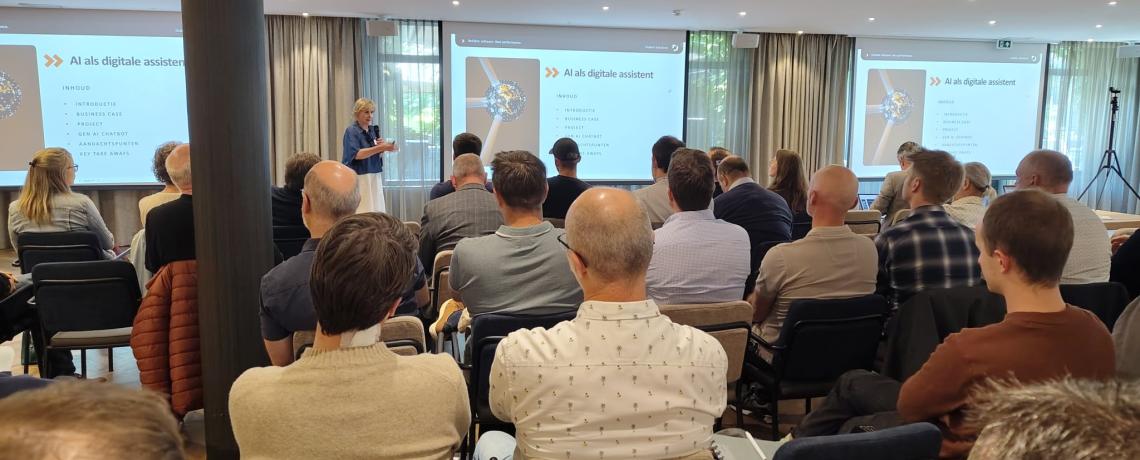
Insights from Three Practitioners
During the seminar, three speakers shared their views on the role of AI in maintenance. Kristof Geilenkotten, Lead AI Engineer at Inetum, explained how organisations can evolve from generative AI to Agentic AI, where multiple AI agents work together on specific tasks and knowledge sources.
Karin Peeters, Sales Director at Dukem Solutions, explored AI as a digital assistant for maintenance technicians. She showed how generative AI can be linked to an EAM or CMMS system, giving technicians faster access to work order history, technical documentation and asset information.
Marcel Van Gogh, Maintenance Manager at Van Geloven, presented the practical case. He showed how Van Geloven, the snack manufacturer behind the well-known Mora brand, evolved from knowledge stored in folder structures and held by individual employees to a more data-driven approach in which generative AI helps make knowledge more readily available on the shop floor.
Why knowledge retention in maintenance is so important
Many maintenance teams are facing a shortage of skilled technical personnel. At the same time, valuable expertise risks being lost when experienced employees leave the organisation. This brain drain has a direct impact on maintenance performance: repairs take longer, troubleshooting becomes more difficult and downtime can increase.
Knowledge retention with AI offers a new approach. Instead of storing knowledge passively in documents or systems, generative AI can help make that knowledge actively available. A technician can ask a question in natural language and gain faster access to relevant information from work orders, documentation and previous experience.
From Generative AI to Agentic AI
An important part of the seminar focused on the difference between a standard Large Language Model, RAG and Agentic AI.
An LLM is strong in language and can understand, summarise and generate text. However, a standard LLM also has limitations. It does not automatically know the internal business context, works with a knowledge cut-off and can provide answers without a clear source or verification.
Retrieval-Augmented Generation, or RAG, adds specific context. The model first retrieves relevant information from connected data sources, such as technical documentation, SharePoint, procedures or work order history. It then uses that information to formulate an answer. This makes the output more concrete, easier to verify and better aligned with the organisation.
Agentic AI goes one step further. It involves multiple AI agents working together, each with a specific role. For example, one agent retrieves information, another interprets documentation, another formulates an answer and another checks the quality. For industrial organisations, this is relevant because precision, auditability, compliance and traceability are crucial.
AI as a Digital Assistant for Maintenance Technicians
During the seminar, the focus also turned to AI as a digital assistant for technicians. The underlying question is familiar to many maintenance organisations: how can you give technicians fast access to all available knowledge and experience from the past?
An AI assistant can combine information from different sources, such as:
work order history;
- technical documentation;
- asset information;
- expert experience;
- captured data from maintenance systems.
When this information is linked to an EAM or CMMS system, it creates a practical application for the shop floor. For example, a technician can ask a question about a failure on a specific installation. The AI assistant then searches relevant work orders and documents, interprets the context and formulates an answer that fits the situation.
In this way, AI is not a standalone chatbot, but targeted support for maintenance, troubleshooting and knowledge transfer.
The Importance of Good Data and Documentation
A clear message from the seminar: the quality of AI depends on the quality of the underlying knowledge base. Generative AI can only deliver value when the data, documents and context are sufficiently reliable.
That is why document management, naming conventions, indexing, data quality and data accuracy are essential. Technical documents must be correctly linked to assets. Work orders must contain useful information. Data must be structured enough to be interpreted correctly.
AI does not automatically solve poor data quality. Preparing the knowledge base remains an important part of every AI project in maintenance.
Practical Case Van Geloven: From Folder Structures to Gen AI
The practical case from Van Geloven made the added value concrete. In 2019, much of the knowledge was still held by individuals or stored in static folder structures. The maintenance organisation depended heavily on experienced employees and partly operated in firefighting mode.
The move towards generative AI created a different way of working. Knowledge became easier to access and more readily available to the entire team. Instead of manually searching through folders, employees can now find relevant information faster through a dynamic AI assistant.
The impact can be seen on three levels.
- At the human level, AI reduces uncertainty, shortens onboarding time and provides more language flexibility on the shop floor. For new or less experienced technicians, knowledge becomes more accessible.
- At the performance level, AI helps teams identify the root cause of failures faster. This can contribute to lower MTTR, less downtime and higher asset availability.
- At the cultural level, AI supports the shift from decisions based on gut feeling to decisions based on data and facts. The case showed how technical knowledge, data and continuous improvement can reinforce each other.
What Can Maintenance Organisations Learn from This?
The seminar made it clear that knowledge retention with AI does not start with technology, but with a concrete need. Which knowledge risks being lost? Which questions do technicians often ask? Which information is difficult to find? Which data is reliable enough to be used as a source?
A successful approach starts with a clearly defined use case. This could be troubleshooting for a specific group of installations, support for work preparation or making technical documentation easier to access. From there, a proof of concept can evolve into a scalable solution.
It is also important that maintenance, IT, engineering and operations work together. AI in maintenance is not purely an IT project. It is a change process involving knowledge, processes, data and people.
Key Considerations for AI in Maintenance
When implementing generative AI in a maintenance environment, there are several key considerations.
The scope and context must be clearly defined. An AI assistant needs to know who it is working for, which sources it is allowed to use and within which boundaries it may provide answers.
Security and access management are essential. Industrial data and technical documentation are sensitive. It is therefore important to work with secure environments, proper authorisations and preferably read-only access to critical data sources.
Human validation remains necessary. AI can support, accelerate and structure the process, but the technician or responsible expert remains the owner of the decision, especially for safety-critical interventions.
Conclusion: From Individual Expertise to Shared Knowledge
The BEMAS seminarshowed that generative AI can play an important role in the future of maintenance and asset management. Its greatest value does not lie in replacing technicians, but in strengthening their access to knowledge.
By making technical documentation, work order history and expert experience easier to access, organisations can reduce knowledge loss, accelerate troubleshooting and support new employees more effectively. AI does not only make knowledge digitally available; it also makes it usable at the moment it is needed.
For maintenance teams, this represents an important shift: from searching to finding, from individual knowledge to shared expertise and from reactive action to more data-driven asset performance.
FAQ: Knowledge Retention with AI in Maintenance
What is knowledge retention with AI?
Knowledge retention with AI means that technical knowledge, documentation and experience are digitally captured, structured and made accessible using artificial intelligence. In maintenance, this helps keep expertise available to the entire team.
How does generative AI support maintenance?
Generative AI supports technicians by helping them find information from work orders, technical documentation and maintenance systems more quickly, and by turning it into clear, understandable answers. This supports troubleshooting, work preparation and knowledge transfer.
What is the difference between LLM, RAG and Agentic AI?
An LLM is a language model that understands and generates text. RAG adds specific business context by retrieving relevant information from documents or data sources. Agentic AI works with multiple specialised AI agents that carry out and check tasks together.
Why is RAG important for maintenance?
Retrieval-Augmented Generation (RAG) is important because maintenance-related answers often need to be based on specific installations, work order history and technical documentation. By retrieving relevant sources, AI-generated answers become more concrete, more reliable and easier to verify.
Can AI prevent technical brain drain?
AI cannot fully prevent brain drain, but it can limit its impact. By making the knowledge of experienced employees, historical interventions and technical documentation more accessible, expertise remains more readily available within the organisation.
How can AI be integrated with an EAM or CMMS system?
AI can be connected to data sources from an EAM or CMMS system, such as asset data, work orders, maintenance history and documents. A technician can then ask questions based on that information via a chatbot or digital assistant.
What should you pay attention to when using AI in maintenance?
Key considerations include data quality, a clear scope, security, access management, proper document structure and human validation. AI only works well when the underlying knowledge base is reliable and up to date.
Does AI replace the maintenance technician?
No. AI supports the technician, but does not replace them. The technician remains responsible for interpretation, safety and execution. AI mainly helps to find the right information faster and make better-informed decisions.
How do you get started with knowledge retention using AI?
Start with a concrete use case, such as troubleshooting for a specific installation or making technical documentation easier to access. Work with a limited scope, test with users, improve the knowledge base and then scale up step by step.
What value does AI add to asset performance?
AI can contribute to faster problem solving, lower MTTR, less downtime, better knowledge transfer, higher availability and more data-driven decision-making. In this way, AI supports a more performant and future-oriented maintenance organisation.
Rewatch the seminar
Explore our training courses
BEMAS Corporate Sponsors