Young technical talent Lotte De Schuyter wins the 2026 Wout Theuws Prize
EEKLO-GHENT - 29 June 2026 – Lotte De Schuyter, a student in Electromechanical Techniques (6EMT) at Richtpunt Campus Eeklo, has been awarded the Wout Theuws Award in the secondary education category by BEMAS, the Belgian maintenance association. She impressed the jury with a strong technical project and a notably proactive attitude during her maintenance internship at CMC Rolbruggen.
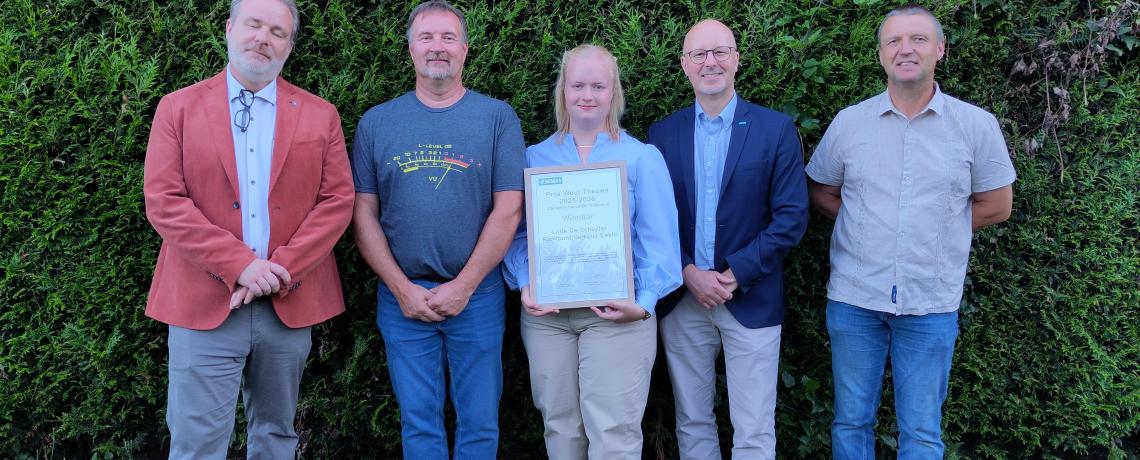
From left to right: Jan Van Dessel (Principal), Dirk Van Goethem (mechanics teacher), Lotte De Schuyter, Wim Vancauwenberghe (BEMAS Director), Kevin Rouzaré (technical advisor for mechanics and welding).
From technical design to precise realisation
For her final project, Lotte worked on a component of a compressed-air-driven boxer engine. More specifically, she was responsible for the development and realisation of a shaft, where not only the mechanical design, but also manufacturability, dimensioning, fit and assembly quality were of great importance. The jury particularly appreciated her strong ability to explain technical choices clearly and with sound reasoning. She not only provided insight into her reasoning, but also answered targeted questions in a clear and structured way, demonstrating a solid understanding of the subject matter.
The technical dossier made a strong impression on the jury. It was described as very complete, accurate and almost usable as a practical manual for manufacturing the component. During the defence as well, Lotte was able to explain clearly why certain choices had been made and why alternative solutions were less suitable. She demonstrated strong technical reasoning, both in response to mechanical and electrical questions.
Internship demonstrates a professional attitude in an industrial maintenance environment
In addition to her final project, her internship at CMC Rolbruggen was also taken into account in the assessment. During this internship, Lotte worked in an industrial environment centred on overhead cranes, hoists, electrical cabinets and technical components. Among other tasks, she carried out work on electrical cabinets, sorted and organised electrical components such as contactors, transformers, frequency drives, auxiliary contacts and braking resistors, brought structure to the technical warehouse racks, made labels to help find parts more quickly, and contributed to the wiring and finishing of an electrical panel. She also supported practical interventions, including work related to breakdown maintenance.
The company’s internship assessment was exceptionally positive. The internship supervisor at CMC Rolbruggen rated Lotte as excellent on virtually all criteria, including skills, technical knowledge, work pace, independence, safe working, social skills, punctuality, administration and environmental awareness. Lotte showed respect for materials, understood the importance of a well-organised spare parts warehouse and worked with attention to correct execution. This is closely aligned with the basic principles of good maintenance: keeping technical installations running reliably through careful, structured and quality-conscious work.
Why Lotte stood out for the jury
The BEMAS jury also emphasised that Lotte demonstrated not only technical skills, but also perseverance, independence and personal commitment. The comment from her internship supervisor that he would have given her more than the maximum score if that had been possible further underlines Lotte’s capabilities. Despite the high quality of the other finalists, the combination of her technical insight, precision, self-criticism, work attitude and growth potential ultimately made the difference and led to Lotte De Schuyter being selected as the winner of the Wout Theuws Prize 2026 in the secondary education category. The jury sees in her an exceptionally strong technical profile with great potential for a future career in maintenance and reliability.
A strong example for girls in STEM
The recognition of Lotte De Schuyter is also particularly relevant from a societal perspective. The most recent Flemish STEM Monitor shows that girls are still strongly underrepresented in technical STEM programmes. In STEM programmes with dual finality, there is a positive evolution: the share of girls increased from 12.62% in 2021-2022 to 15.43% in 2024-2025, bringing it close to the interim target of 15.90%. In STEM programmes with labour-market finality, however, the trend is worrying: the share of girls fell from 6.89% to 4.89%, far below the interim target of 12.80% and the 2030 objective of 20%. These programmes are precisely the ones that are crucial for the inflow into technical professions such as maintenance, electromechanics, installation, energy, production and industrial services. Strong examples such as Lotte show that girls not only have a place in these programmes, but can also excel through technical insight, precision, a sense of responsibility and professional growth potential.
BEMAS Corporate Sponsors