Ultrasonic inspection of low speed machines
The founding principle of predictive maintenance is "prevention is better than cure". This requires a good knowledge of the machines, taking into account the warning signs of wear and tear and the economic impacts.
Today, predictive maintenance is based on various technologies that maintenance departments can use to assess the risks of failure, their frequency and the associated severity levels
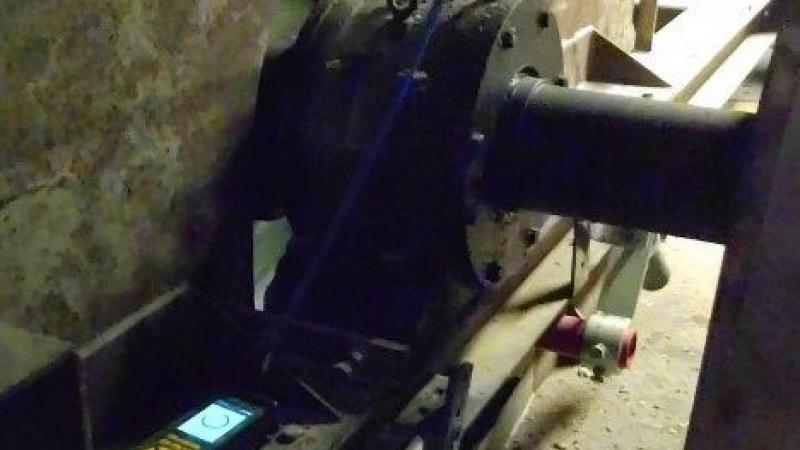
But it is a different matter when it comes to selecting the right analysis tools, technology and indicators for the early detection of a fault on a rotating machine, especially low-speed machines. Ultrasonic technology is used to make this diagnosis, as it can be easily and efficiently implemented.
This machine runs at 8 revolutions per minute (RPM)
The maintenance department of a world-renowned company had detected an unusual noise on a strategic production machine.
The sudden stop of this machine would have led to the complete shutdown of the production site. The cost of replacing the four bearings in question, which had not been stocked, the downtime required to supply them, and the labour costs associated with replacing them, not to mention the "technical unemployment" of some of the staff, were all enormous.
The challenge here was twofold: to check the condition of these bearings and to diagnose the cause of the noise.
A diagnosis was made using an ultrasonic measuring instrument, SDT340 in its FOCUS mode, which can measure at a sampling rate of 256 K per second.

The spectrum shows us a shock at the rotational speed (0.139 Hz) of the controlled rotating machine shafts with its harmonics. Subharmonics at 0.5 x rotational speed are also noted, and this spectrum characterises the rotational backlash due to high friction or impacts. No shock related to bearing frequencies is detected. The time spectrum will confirm this diagnosis.

The time spectrum shows us that the shocks we see are indeed shocks related to the rotation speed of the machine shafts at 0.139 Hz, i.e. a rotation speed of 8.34 rpm. These shocks are not necessarily constant in terms of energy at each revolution of the shafts (time recorded over a period of 2 minutes).
The problem encountered is related to wear on the shafts and the discs that are mounted on these shafts and which generate friction.
The maintenance department now knows the origin of the noise and has a good knowledge of the condition of these bearings. All that remains is to monitor them periodically.
BEMAS Corporate Sponsors