Maintenance processes, an essential prerequisite
The maintenance function, whatever the size of your company or the industrial sector in which you work, is a complex "machine" made up of a multitude of functions that interact with each other.
Each of these functions must be able to respond to the different situations that arise on a daily basis (inputs), to process them by carrying out a series of actions and to produce a deliverable (outputs) with the required level of quality, in a defined period of time, at a controlled cost.
All these actions, scheduled and carried out by resources, whether human and/or computer-based, form a process.
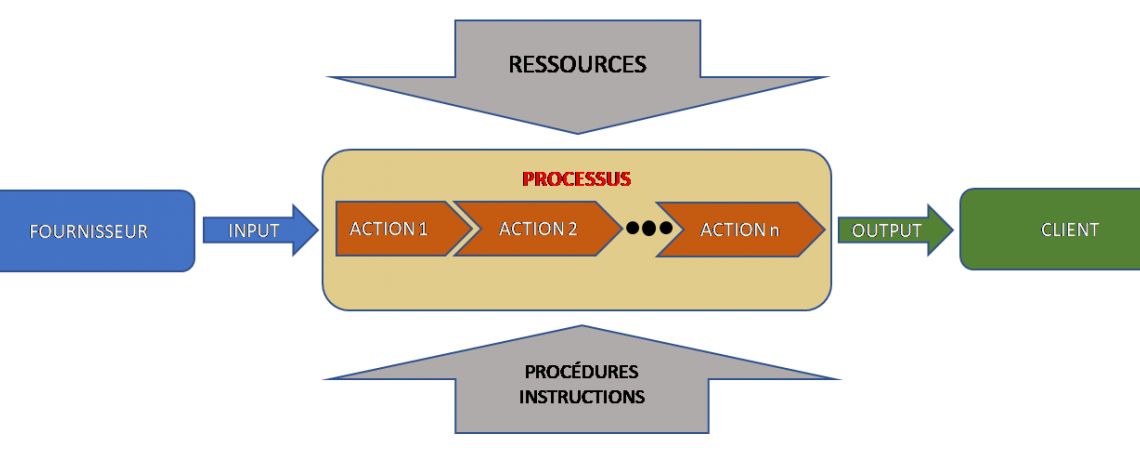
All the activities of maintenance, reliability, preparation, planning, execution, storage, purchasing, etc. are therefore governed by a set of processes.
Throughout these activities, the outputs of some become the inputs of others. The maintenance function is therefore a succession of processes that follow one another, constituting a value chain where the slightest "weak link" can deteriorate the overall efficiency of the organisation.
" I write what I do and I do what I write "
Knowing that in a continuous improvement approach, whether in maintenance or in production, the improvement of the organisation, and therefore of the processes that support it, is the source of the greatest gains, it is quickly understood that the efficiency and stability of the processes are essential.
Writing processes helps to clarify the who, what, where, how, how, why. There are various tools for describing and documenting processes: SIPOC, BPMN, etc.
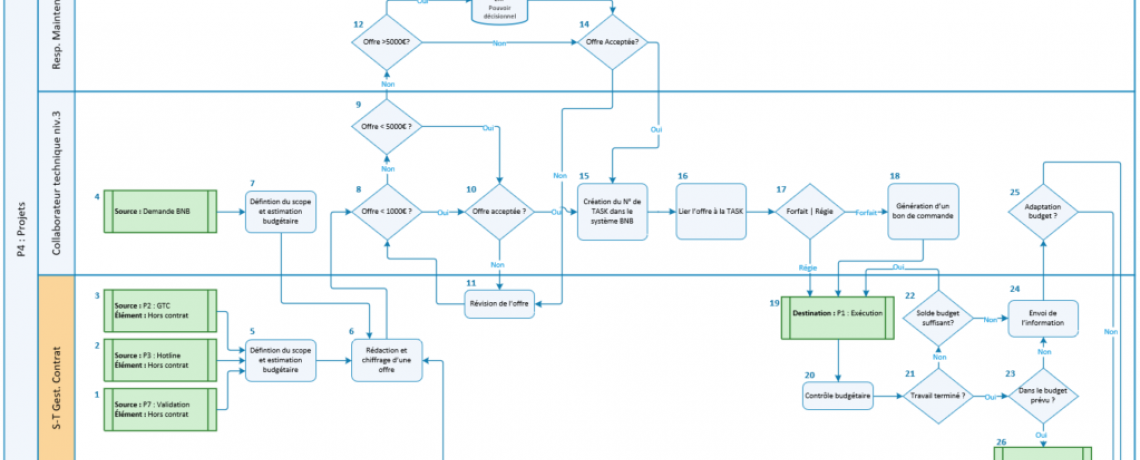
Example of a BPMN process - Source ENGIE Solutions
As an expert in maintenance engineering and as a consultant at ENGIE Solutions, I see on a daily basis that this approach is rarely deployed:
- The ways of doing things differ from one department to another, and even from one person to another within the same department;
- Not all activities are framed by processes, there is an "artistic blur" in the way things are done;
- The existing processes are rarely documented by clear operating procedures or work instructions.
The method is divided into two main steps: describe the way things are done today, the "As Is", think about possible improvements, identify the gaps, the "holes in the carpet" and describe the desired way of working, the "To Be".
A Gap Analysis enables the identification and quantification of the effort required to move from one to the other and therefore to prioritise the actions to be taken.
It should be noted that in an approach to digitising maintenance, the absence of formalised processes is likely to lead to the implementation of non-adapted, ineffective solutions, which will eventually lead to rejection by end users.
Writing and formatting maintenance processes is a basic and good practice in maintenance. It is an essential step if you want to deliver an efficient service.
I will conclude with this quote from W. E. Deming (1900-1993):
''If you can't describe what you are doing as a process, you don't know what you're doing. ''
BEMAS Corporate Sponsors