Laurens Joosten receives Wout Theuws Award for bachelor’s thesis on online vibration measurements
GEEL – 30 june 2026 – BEMAS vzw, the Belgian association for maintenance and asset management, has presented the Wout Theuws Award 2025-2026 in the Professional Bachelor category to Laurens Joosten, a Professional Bachelor in Electromechanics student specialising in maintenance technology at Thomas More campus Geel. Laurens received the award for his bachelor’s thesis “Didactic test rig for online vibration measurements”, a practical training setup that helps students understand how vibration measurements can be used for condition monitoring, predictive maintenance and fault diagnosis.
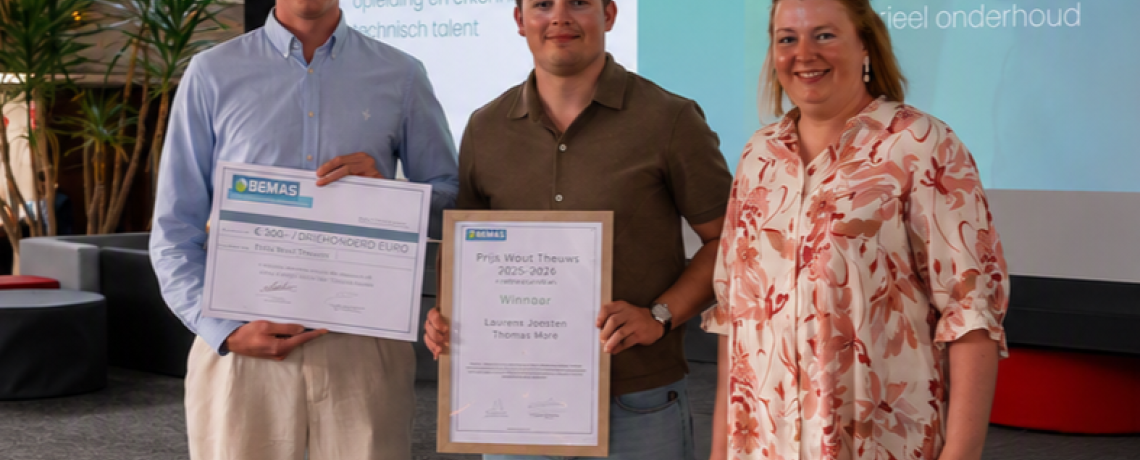
The Wout Theuws Award is an initiative of BEMAS and recognises strong final-year projects that make a clear contribution to maintenance, reliability and asset management. With this award, BEMAS aims to encourage young talent in technical education to continue developing their skills in a field that is essential to the reliability, safety and competitiveness of industry.
The jury saw Laurens Joosten’s work as a highly relevant contribution to maintenance technology. His bachelor’s thesis combines a technical realisation with clear didactic value and fits closely with the evolution towards data-driven and predictive maintenance. Laurens achieved a final score of 81.3 / 100, which led to his selection as winner in the Professional Bachelor category.
Letting machines speak through vibrations
Every machine says something about its condition. A motor, pump, fan, gearbox or compressor that operates correctly has a specific vibration pattern. When wear, imbalance, misalignment or other mechanical problems occur, that pattern changes. By measuring and analysing vibrations, maintenance technicians can detect anomalies at an early stage, often long before a machine actually fails.
This is exactly what Laurens Joosten’s bachelor’s thesis focuses on. He designed and built a didactic motor-gearbox setup on which controlled mechanical faults can be introduced. The setup was moreover built using industrial equipment from the field: the motor with gearbox was supplied via Van Loock Motoren and the electrical panel via Signify Turnhout. Sensors measure vibrations at various points in the setup. The measurement data are then made available online, allowing students to learn how to interpret vibration spectra and how to link a machine fault to the resulting measurement pattern.
For maintenance technology students, this is particularly valuable. Vibration analysis often remains abstract when it is only taught in theory. Thanks to this setup, future students can literally see how a machine reacts when a fault occurs. They learn to recognise the difference between a normal condition and an anomaly, and gain a better understanding of how modern condition monitoring is applied in industrial environments.
Predictive maintenance in practice
Laurens’ setup ties in closely with the shift towards predictive maintenance. Instead of waiting until a machine fails, or replacing components preventively without knowing whether this is already necessary, companies increasingly use measurement data to monitor the actual condition of their machines. This allows them to plan maintenance more effectively, avoid unexpected downtime and replace parts at the right time.
This approach is an essential part of modern industry. In an Industry 4.0 environment, machines are connected to sensors, cloud platforms and intelligent analytics software. Machine data are collected continuously or periodically and used to identify trends, anomalies and risks. Vibration measurements play an important role in this process, especially for rotating machinery such as motors, pumps, fans, compressors and gearboxes.
The link with artificial intelligence is also becoming increasingly important. AI systems can analyse large volumes of measurement data, recognise patterns and detect anomalies faster than traditional manual checks. However, technical expertise remains essential. Maintenance professionals must understand what the data mean, which failure mechanisms may be behind them and which actions are required. Laurens’ didactic setup helps students build exactly that bridge between technology, data and practical maintenance insight.
Collaboration with I-care
The bachelor’s thesis was carried out in collaboration with I-care, a Belgian technology unicorn and international player in predictive maintenance and machine health. I-care specialises in monitoring the health of industrial machines using sensors, data analysis and AI-supported platforms.
This collaboration played an important role in Laurens’ project. By using industrial sensor technology and analysis tools, students gain access to technology that is also used in real production environments. This makes the setup not only strong from an educational perspective, but also highly relevant to the world of work.
The collaboration also demonstrates the importance of the link between education and industry. New maintenance technologies are developing rapidly. By introducing students to modern measurement methods, online data platforms and data analysis during their studies, they are better prepared for the maintenance roles of tomorrow.
Reliable machines have societal value
Better vibration measurements and more reliable maintenance do not only benefit companies. They also have a broader societal impact.
When machines operate more reliably, the risk of unexpected downtime decreases. This means less production loss, fewer urgent repairs, less waste of parts and raw materials, and more efficient energy use. In sectors such as food, chemicals, pharmaceuticals, energy, infrastructure and manufacturing, reliable maintenance also contributes directly to safety, security of supply and sustainability.
A well-maintained machine also lasts longer. This reduces the need for premature replacement and helps companies manage their assets more sustainably. Predictive maintenance therefore supports not only economic performance, but also safety, circularity and responsible asset management.
With his bachelor’s thesis, Laurens Joosten delivered more than a technical test setup. He built a learning tool that helps future maintenance professionals understand how data, technology and technical expertise together contribute to more reliable machines and a stronger industry.
Jury decision
The BEMAS jury particularly appreciated the clear link with condition monitoring, predictive maintenance and fault diagnosis, the practical usability of the didactic setup and the high added value for the next generation of Thomas More students.
In the evaluation, Laurens achieved good to very good scores across the various criteria. The added value for the client, the relevance of the subject matter for maintenance technology and the clear link with vibration analysis played a decisive role in the final decision.
For the jury, the combination of maintenance relevance, practical applicability and didactic added value ultimately made the difference. With this recognition, BEMAS rewards a bachelor’s thesis that strongly combines technical realisation, educational value and societal relevance.
“Predictive maintenance is of major economic importance for the competitiveness of our production companies. By detecting emerging machine problems in time, companies can avoid unexpected downtime. At the same time, predictive maintenance also helps prevent excessive maintenance: parts are not replaced too early, interventions can be planned more effectively, and the costs of unnecessary downtime, spare parts and labour hours are reduced. This makes maintenance not only more technical and smarter, but also more strategic for industry.”
Wim Vancauwenberghe, Managing Director of BEMAS and jury member
“As his supervisor, I am extremely proud of what Laurens has achieved. With his didactic setup for online vibration measurements, he makes predictive maintenance tangible and future-oriented. The collaboration with I-care, as well as the particularly driven collaboration with Laurens himself, shows how education and the professional field can truly strengthen one another.
The Wout Theuws Award, an initiative by BEMAS, is the icing on the cake for his commitment and dedication. This project is a textbook example of the MORE professional in action: innovative, entrepreneurial and creating societal impact.”
Niels Verellen, supervising lecturer/promoter at Thomas More
“It was wonderful to see how Laurens approached his project; his passion for vibration analysis grew day by day. With his award-winning bachelor’s thesis, he not only strengthened the connection between I-care Group and Thomas More Geel, but also built a safe and user-friendly setup. Laurens is also an absolute pleasure to work with — his contract is already ready here!”
Tim Franken, company promoter at I-care
BEMAS Corporate Sponsors