Global Maintenance Day 2026 at EXAIL: maintenance as a driver of industrial resilience
On 9 June 2026, BEMAS brought together the maintenance, reliability and asset management community at EXAIL Robotics Belgium in Ostend for Global Maintenance Day. Under the international theme “Resilience in Maintenance, Securing Reliability for the Future”, one central message stood out: maintenance is not a function that only becomes visible when something goes wrong, but a strategic discipline that ensures assets, installations and critical systems continue to perform reliably.
The 2026 edition took place at a particularly relevant location. EXAIL Robotics Belgium is active in autonomous systems for maritime mine countermeasures and develops technology that must operate in complex, high-risk and often difficult-to-access environments. This made the site in Ostend a powerful setting to demonstrate the practical importance of maintainability, reliability, technical knowledge and resilience.
Le Média Maintenance also attended as accredited press and later published an extensive analysis of the evening. Their article captured the essence of Global Maintenance Day well: organisations that take maintenance seriously look beyond machines, installations or interventions. They also consider safety, knowledge transfer, industrial continuity and strategic autonomy.

A strong edition at an exceptional location
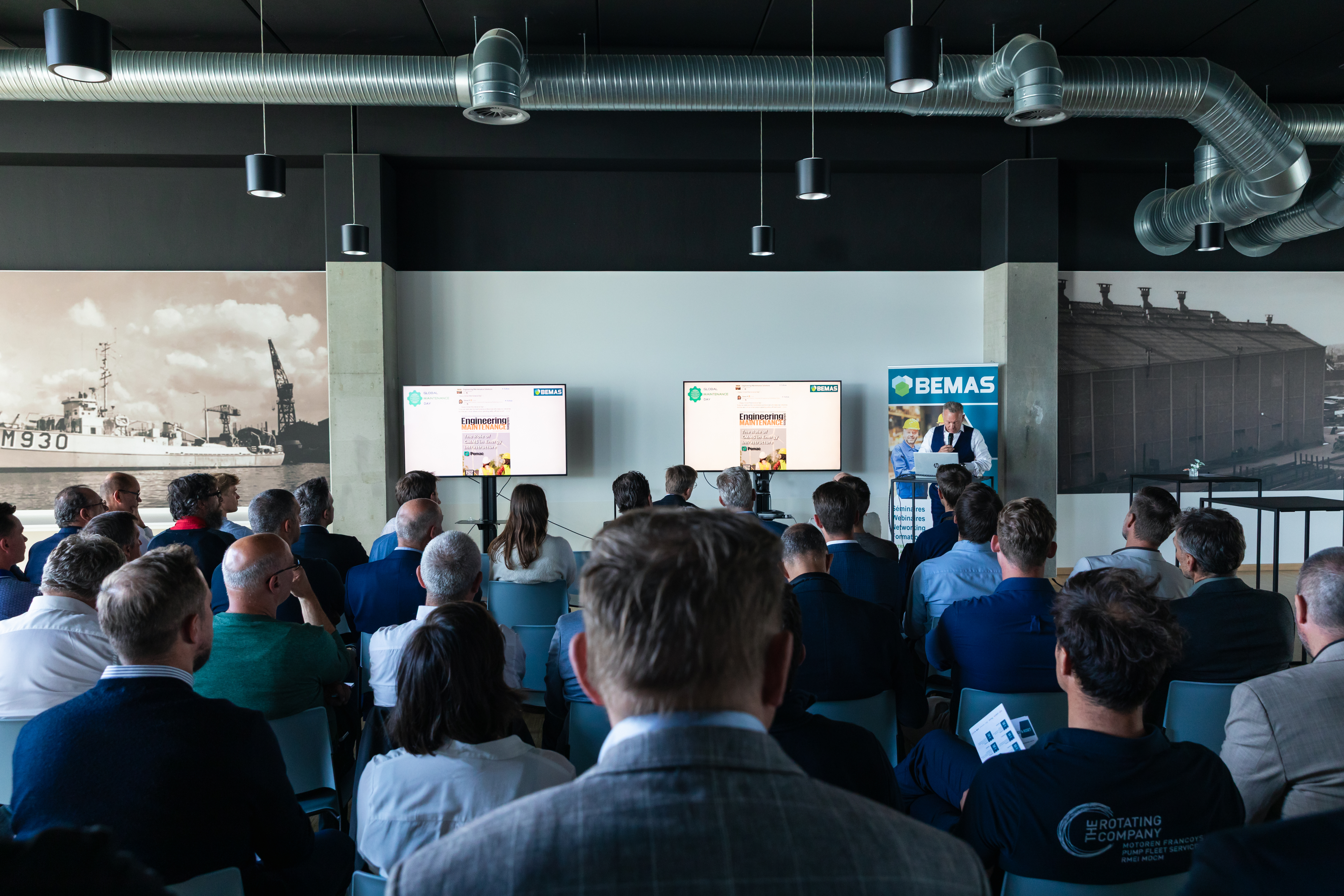
Global Maintenance Day 2026 at EXAIL Robotics Belgium combined strategic reflection with a concrete look at industrial practice. Participants first attended a keynote by Wim Vancauwenberghe, Director of BEMAS, followed by a presentation by Steven Luys, CEO of EXAIL Robotics Belgium. The programme then continued with a visit to the production environment and a networking moment.
This combination made the event particularly valuable. The themes discussed during Global Maintenance Day did not remain abstract. They were immediately connected to an industrial environment where reliability, maintainability and technical expertise are of strategic importance. In autonomous systems for maritime mine countermeasures, there is little room for error. Assets must function reliably, including in corrosive maritime environments, with limited connectivity and under operational pressure.
For BEMAS, this was exactly the right context in which to organise Global Maintenance Day 2026. The event showed how broadly maintenance must be understood today: from preventive maintenance and spare parts management to digital twins, knowledge retention, technical training and strategic decision-making.
Maintenance as a strategic function
In his keynote, Wim emphasised that maintenance is increasingly evolving from a traditional support function into a strategic pillar within organisations. For a long time, maintenance was mainly seen as a cost: necessary, but often put under pressure when budgets had to be reduced. That view is no longer sustainable.
In a world marked by geopolitical tensions, fragile supply chains, energy challenges, climate pressure and growing dependence on critical infrastructure, maintaining existing assets is becoming increasingly important. Building new installations remains relevant, but ensuring that existing installations continue to operate safely, reliably and efficiently is at least as important. This applies to industry, but also to energy supply, transport, infrastructure, defence and public services.
Maintenance often creates value by preventing something from happening: a failure that does not occur, unplanned downtime that is avoided, an incident that does not take place, or an asset that continues to perform reliably for longer. This value is not always visible in traditional reporting, but it is essential for continuity, safety and economic resilience.
The lighthouse metaphor
One powerful image from the analysis by Le Média Maintenance is the comparison between maintenance professionals and lighthouses. In clear weather, they are barely noticed, but when the storm comes, they become indispensable.
This metaphor captures the tension around maintenance very well. Good maintenance is often only noticed when it is missing. As long as installations keep running, production lines continue to operate and assets function safely, maintenance may seem self-evident. But behind that reliability are planning, inspections, technical interventions, data analysis, experience and decisions that are often made under time pressure.
For BEMAS, this is an important message. Organisations that want to strengthen industrial resilience must give maintenance professionals more recognition. Their work is not only technical, but also strategic. They protect organisational continuity, reduce risks and help preserve knowledge about installations and systems.
EXAIL Robotics Belgium: maintenance in extreme conditions
The presentation by Steven Luys provided a unique insight into the world of EXAIL Robotics Belgium. The company develops autonomous systems for maritime mine countermeasures. These systems are deployed in conditions where human presence is dangerous or impossible. This makes reliability and maintainability crucial.
The traditional image of maintenance, where a technician can easily access a machine or installation, does not apply here. Autonomous drones and underwater systems may operate in maritime environments with corrosion, limited communication and unpredictable deployment cycles. Some systems may remain on standby for a long period before having to become operational quickly. In other cases, they are located in places where inspection or repair during operation is impossible.
This requires a different way of thinking. Maintenance must be considered from the design phase onwards. The performance of the system is not the only important factor. It is equally important to determine how the system can later be maintained, tested, monitored and repaired. Reliability, technical documentation, spare parts, training and field support therefore become an integral part of the design.
From maintenance to maintainability by design
An important insight from the EXAIL case is that maintenance cannot simply be added to complex systems afterwards. In high-tech assets, maintainability must be built in from the start. This principle, often described as maintainability by design, is becoming increasingly important in sectors where systems are becoming more complex, more autonomous and more critical.
This does not only apply to defence applications. In the process industry, energy, infrastructure, transport, pharmaceuticals and manufacturing, assets are also becoming more complex and more dependent on software, sensors, data flows and integrated systems. As a result, the traditional separation between design, production, operation and maintenance is becoming smaller.
For maintenance and reliability teams, this means they need to be involved earlier in the process. Their practical knowledge is needed to build realistic maintenance strategies, understand failure modes, dimension spare parts correctly and make maintenance procedures workable. Maintenance is therefore not only an execution-oriented discipline, but also a source of knowledge for better engineering and better asset management decisions.
Predictive maintenance and digital twins are becoming necessary
The analysis by Le Média Maintenance also strongly emphasises predictive maintenance and digital twins. In many organisations, these technologies are still seen as innovative or future-oriented. For critical systems that are difficult to access, however, they are increasingly becoming a necessary condition for guaranteeing reliability.
When assets cannot easily be inspected or repaired, the importance of data increases. Organisations need to be better able to predict when components are at risk, how operating conditions affect asset lifetime and which interventions are required before a failure occurs. Digital models, historical data, sensor data and technical knowledge must come together in a maintenance approach that does not merely react, but anticipates.
For the broader maintenance community, this is a clear wake-up call. Predictive maintenance and digital twins are not goals in themselves. They are valuable when they help organisations make better decisions, reduce risks, structure knowledge and manage assets more reliably.
The human factor remains central
In addition to technology, the human factor was also clearly highlighted. Steven Luys explained that the biggest challenge in developing EXAIL Robotics Belgium was not only technological or financial, but above all human: finding, attracting, training and retaining the right technical profiles.
This closely reflects a challenge recognised across the entire maintenance world. Demand for technicians, engineers, reliability specialists and asset management profiles continues to rise, while the inflow of new talent remains limited. At the same time, a great deal of experience is lost when older technicians retire without their knowledge being structurally transferred.
That is why knowledge sharing remains a core task for BEMAS. Training courses, networking moments, practical cases, awards and events such as Global Maintenance Day help make technical professions more visible and strengthen expertise within the sector. Technology can support maintenance, but without people with practical knowledge, critical insight and a strong sense of responsibility, reliability remains vulnerable.
Resilience in Maintenance
The theme of Global Maintenance Day 2026, “Resilience in Maintenance, Securing Reliability for the Future”, was made tangible throughout the evening. Resilience does not emerge only when a crisis breaks out. It is built in advance through good procedures, strong technical teams, reliable data, knowledge transfer, maintenance strategies and a culture of anticipation.
Maintenance plays a key role in this. Organisations that manage their maintenance well are better prepared for disruptions. They can respond more quickly, assess risks more accurately and use their assets safely and efficiently for longer. This makes maintenance relevant not only for operational performance, but also for sustainability, safety and strategic autonomy.
At a time when European industry is under pressure from geopolitical uncertainty, rising costs, labour shortages and transition challenges, the role of maintenance is only becoming more important. Reliability is not a given. It is the result of conscious choices, technical expertise and continuous attention.
A broader message for the sector
The analysis by Le Média Maintenance confirms BEMAS’ broader mission: to position maintenance, reliability and asset management more strongly as strategic disciplines. The challenges visible at EXAIL are recognisable in many other sectors. There too, assets need to last longer, operate more safely, consume less energy and be monitored more effectively through data.
Global Maintenance Day 2026 showed that maintenance professionals make a crucial contribution to the future resilience of organisations. They ensure that technology keeps working, that knowledge is preserved and that investments continue to deliver value throughout the full life cycle of assets.
Thank you to EXAIL, the participants and Le Média Maintenance
BEMAS would like to thank EXAIL Robotics Belgium for their warm welcome and the unique insight into their activities. We also thank all participants who made Global Maintenance Day 2026 a strong and connecting moment for the sector.
Finally, we thank Le Média Maintenance for their presence and their extensive analysis of the evening. Their article clearly shows why maintenance deserves more attention today than ever before: not as a cost, but as a strategic driver of reliability, safety and industrial resilience.
Read the full analysis by Le Média Maintenance
Discover Le Média Maintenance’s full analysis of Global Maintenance Day 2026 at EXAIL Robotics Belgium.
BEMAS Corporate Sponsors