Global Maintenance Day 2026
Maintenance Magazine's latest edition puts Global Maintenance Day 2026 in the spotlight. The article explains why maintenance is far more than a technical support function and why maintenance professionals deserve greater recognition.
Curious? Read on!
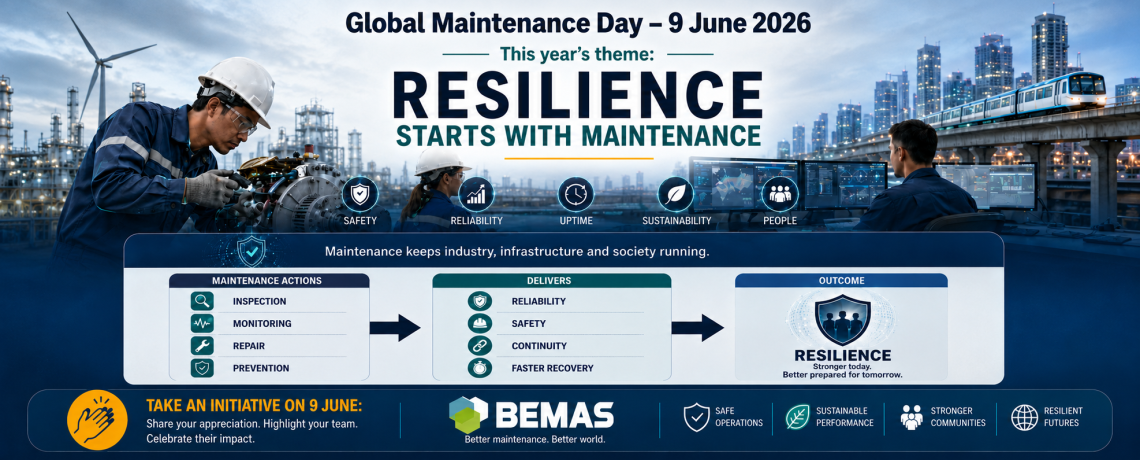
Global Maintenance Day 2026: Maintenance as a Foundation for Resilience in an Uncertain World
On 9 June, give the men and women of maintenance a bunch of flowers. Send them a thank-you email. Give them a thumbs up. Because they are the ones who kept the factory, the infrastructure, the technology, the machinery and the processes running — safely and energy-efficiently. That not only extends the life of the entire installation; it also prevents the ecological impact of premature replacement. The added value is enormous, even if it isn't always understood. Maintenance does vital work quietly and modestly, yet remains largely invisible. As a result, the profession attracts few young people. And yet the maintenance technician remains a critical shortage occupation, even in economically challenging times. The shortage of maintenance professionals is almost a global phenomenon — and that tide needs to turn if we want to safeguard our prosperity.
Global Maintenance Day is an initiative of the Global Forum for Maintenance and Asset Management (GFMAM), which brings together like-minded organisations worldwide to share knowledge and experience on maintenance and asset management and to further develop the profession. A driving force behind this was, and still is, the European Federation of National Maintenance Societies (EFNMS), of which Belgium's BEMAS is a member.
BEMAS director Wim Vancauwenberghe was present at the founding meeting of the Global Forum in London in 2010, took the initiative in 2020 to establish a world day for maintenance, and today sits on the Global Maintenance Day organising committee on behalf of EFNMS.
Global Maintenance Day
Maintenance professionals make an essential contribution every day, even if that contribution is not always fully visible or recognised everywhere. In the eyes of management, maintenance is sometimes still seen as a cost, whereas it is in fact an important source of added value. The world day for maintenance aims to make that added value visible by motivating as many organisations and companies as possible to take an initiative around the theme of maintenance. "In that way, we also bring a positive message to the media," says Vancauwenberghe. "Belgium has historically had a solid practice in preventive maintenance, partly thanks to the presence of the chemical, pharmaceutical and nuclear industries. Strict safety legislation and regulation was and still is an important catalyst. In recent years, innovative providers of predictive maintenance solutions have also emerged, and we are seeing those new technologies effectively finding their way into practice."
AI takes maintenance to a new level
"In essence, you need to perform maintenance when it is needed," says Wim Vancauwenberghe. Where the focus in the past was strongly on preventive, time-based maintenance, we know today that various failure mechanisms are at play and that many breakdowns occur rather randomly. We cannot always predict when external factors will arise, but we do know that when they do, they trigger degradation.
"Artificial intelligence is playing an increasingly important role in this. By continuously analysing sensor and process data and recognising patterns, AI can detect anomalies much faster. In the near future, AI agents will also help us support maintenance processes and schedule interventions at the optimal moment. At the same time, we must continue to focus on eliminating the root causes of defects. The future of maintenance lies in the smart combination of insights and technology. A well-considered, data-driven approach to maintenance also strengthens the resilience of organisations — not coincidentally the central theme of Global Maintenance Day 2026."
Maintenance as a lever for resilience
We live today in a context of increasing uncertainty and disruption. Industrial supply chains are increasingly confronted with external shocks: geopolitical tensions, energy crises, raw material scarcity and cyber threats. In that environment, resilience — the ability to absorb disruptions and recover quickly — is becoming a strategic priority. Organisations with a strong maintenance function have the capacity to keep installations running reliably, resolve breakdowns quickly and limit production losses. This applies not only in an industrial context. In Ukraine, for example, it is often the technical services that get essential infrastructure back up and running after damage or failure.
Resilience requires deep technical knowledge, experience and craftsmanship. The ability to act inventively under pressure and find solutions with limited resources is not built up ad hoc. It is the result of daily practice, systematic maintenance and thorough mastery of assets. Maintenance is thus evolving into a strategic lever for continuity and robustness.
"Something as vital to society as maintenance deserves an international day. We even want to get Global Maintenance Day onto the officially recognised UN calendar." Vancauwenberghe calls on all policymakers to support the idea. The first step, however, is for everyone in the business world to get on board and put the spotlight on the maintenance department for at least one day!
Read the original article in Dutch: https://www.maintenance-magazine.be/nl/artikels/item/426/global-maintenance-day
Read the original article in French: https://www.maintenance-magazine.be/fr/artikels/item/426/global-maintenance-day
BEMAS Corporate Sponsors