Energy saving 4.0
It has become almost commonplace to say that leak detection on compressed air networks can pay off! Who hasn't seen these tags indicating the presence of a leak in a network? And then what? Well, nothing more ... for lack of a proper action plan.
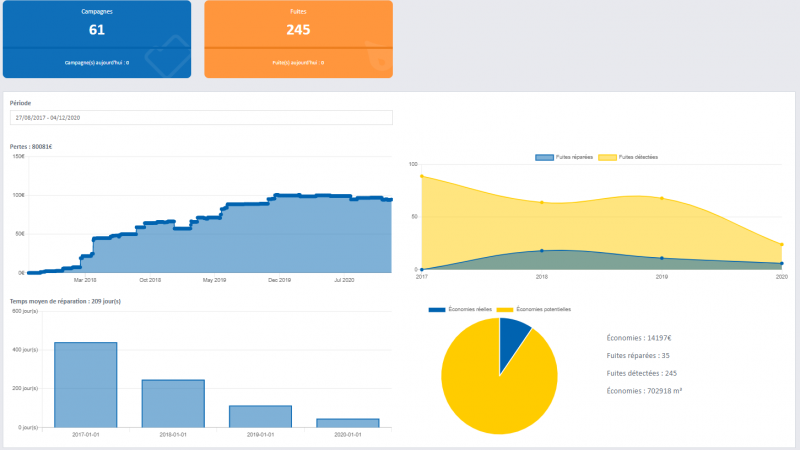
And yet ... this well-executed task of "hunting and repairing" should be a top priority when you know that leaks "consume" 30 to 40% of the volume of air produced! These figures speak for themselves, a planned leakage plan is essential as it contributes directly to reducing the carbon footprint and saves a lot of money. But why then, you may ask, is this subject still relevant, why do things not change easily on the ground? Because the actors do not put in place a proper battle plan including purchasing, training, hunting and repair.
The use of an ultrasonic detector is the most widespread means of locating a leak. A tool that is inexpensive, intuitive thanks to its listening capabilities, and easy to use, it has been recognised for many years as offering good value for money, provided that it meets a few basic principles: detecting is good, but locating and measuring accurately is better. Because measuring is also knowing, and because the digital age makes it possible, both free and paid applications have emerged. They allow reporting and in some cases the calculation of the approximate gains of a leak hunting campaign. More recently, acoustic cameras have appeared on the market. More expensive, they are also more practical in use and allow for long-range detection and, in the best of cases, the visualisation of a leak on a colour screen.
The range of solutions is wide! So what is it?
In fact, the most important work to be done by service providers and maintenance technicians is not so much locating leaks but rather producing a clear report that allows the team in charge of plugging leaks, sources of lost Euros, to take quick and effective action. The rest is a matter of repetition and communication:
- A compressed air network is often in demand 24 hours a day and if "leaks that disappear add up to a lot of money", sooner or later other network leaks will appear. It is therefore essential to carry out several leak hunts during the year.
- Internal communication of the overall gains made thanks to the "hunts" will help to enhance them. Good internal communication allows other departments to become aware of the situation and enhances the preventive contribution of the maintenance worker, who will no longer be seen as the fireman on duty who disrupts production.
In summary, the failure to implement an effective plan to reduce the energy costs associated with wasted compressed air is not the fault of technology. It offers effective solutions that can be afforded by everyone, from the well-stocked to the not so well-stocked.
The real problem is, as is often the case, the willingness to put in place a sustainable plan, including leakage control AND a documented worksheet. In short, this is another story of corporate culture, one that involves the bottom and the top and vice versa!
By André Degraeve, Vice President BEMAS, SDT Ultrasound Solutions
BEMAS Corporate Sponsors