AI produces insights. But who turns them into results?
Industrial companies are investing heavily in AI. The technology can detect patterns, predict failures, identify anomalies and process large amounts of operational data faster than ever.
Yet many organisations face the same challenge: how do they turn those insights into decisions, actions and measurable business impact?
Because predicting what might happen is only part of the equation. An AI model may indicate that a critical asset is likely to fail, that maintenance should be brought forward or that a process is drifting away from optimal performance. But someone still needs to decide what to do with that information.
From prediction to decision-making
Who validates the recommendation? Who determines the priority? Who takes ownership of the action? And how do you ensure that the decision actually results in better reliability, lower risk or improved financial performance?
That is where many AI initiatives become difficult to scale.
The challenge is therefore not simply to build better models or generate more accurate predictions. Organisations also need to design the processes and decision-making structures around those insights.
AI must become part of the way maintenance, reliability and operations teams work. That means connecting technological capabilities with clear responsibilities, workflows and business priorities.
At Asset Performance Conference 2026, Tom Rombouts, Reliability Transformation Leader at PDM, and Sam Lenders, Business Leader Growth & Innovation at PDM, will explore how industrial organisations can close this gap.
Their session, Architecting AI for Reliability and Industrial Decision-Making – Moving Beyond AI Pilots Toward Scalable Industrial Performance, shifts the focus from what AI can predict to what organisations need to put in place to turn those predictions into operational and financial results.
Why promising AI pilots often struggle to scale
Many industrial AI projects start with a clearly defined technical use case: predicting equipment failures, detecting anomalies or optimising maintenance intervals.
A successful pilot can demonstrate that the technology works. But scaling that success across assets, production lines or sites introduces a different set of challenges.
Organisations need to determine:
- how AI insights fit into existing maintenance and reliability workflows;
- which decisions can be supported or automated and which still require human judgement;
- who is accountable when AI identifies a risk or recommends an intervention;
- how recommendations are prioritised against production, maintenance and financial constraints;
- how solutions can be standardised and scaled without losing operational context;
- and how the resulting impact can be measured.
Without these elements, even technically strong AI solutions risk remaining isolated pilots rather than becoming part of day-to-day industrial decision-making.
Designing the path from insight to impact
Creating value from AI therefore requires more than algorithms and data.
Technology, people and processes need to work together. Reliability and maintenance teams must understand how insights are generated and how they should be interpreted. Decision rights need to be clear. Workflows must allow recommendations to be translated into concrete actions. And organisations need to connect those actions to measurable outcomes.
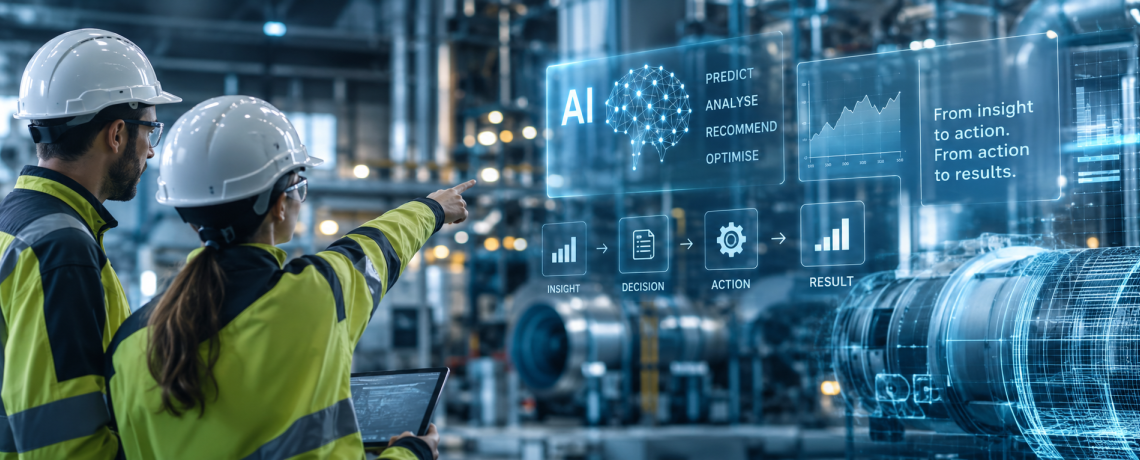
The full value chain becomes:
Insight → Decision → Action → Result
The quality of the AI insight matters, but so does every step that follows.
For industrial organisations, this raises an important strategic question: how should AI be architected not only as a technology, but as part of the operating model for reliability and asset performance?
That is the central question Tom Rombouts and Sam Lenders will address during their session.
Session
1.2.4 Architecting AI for Reliability and Industrial Decision-Making – Moving Beyond AI Pilots Toward Scalable Industrial Performance
Speakers
Tom Rombouts, Reliability Transformation Leader, PDM
Sam Lenders, Business Leader Growth & Innovation, PDM
BEMAS Corporate Sponsors