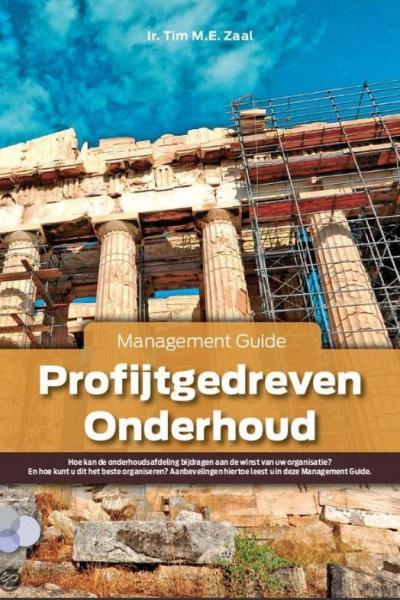
Profijtgedreven Onderhoud
How can the maintenance department contribute to your organisation's profits? And how can you best organise this? You can read the recommendations in this Management Guide.
Maintenance as top managers should actually experience it, such as: what does it contribute to the profit, increase safety, etc.? Can we organise maintenance in such a way that it is World Class and is recognised in the Board room as an important quality factor for the optimal performance of the assets?
But will maintenance ever be a conversation in the Board room? This book makes an attempt to make the maintenance function a very profitable business function for top management and financial management. Until now, the word maintenance itself always causes discomfort in the boardroom. Why is that? It seems as if the worlds of top management, financial management and maintenance management are on different planets. The paradoxical fact arises when the private luxury assets of the top come up for discussion: maintenance is then suddenly no longer a difficult cost item, but a necessary expense to be able to present good and reliable with the luxury yacht, the exclusive car or the private jet.
Top managers think mainly in terms of costs and benefits, added value, new markets, safety and image damage, opportunities and risks. Maintenance does not seem to be an important item on their agenda. Maintenance managers think in terms of technology, breakdowns, technical problems, maintenance planning, and not so much in terms of costs and benefits. Because of this difference in thinking, most people fail to see that the maintenance function can create a lot of added value and opportunities for the organisation.
This Management Guide brings both worlds together. The book considers Maintenance as a business-driven process. Top management and maintenance managers learn how maintenance activities can be organised in such a way that they contribute to the organisation's profits. And also how maintenance can be an important quality factor.
How can we demonstrate this, this profit? Central to this is the concept of Maintenance Requirement, which is new to many. Each asset generates hours of downtime for repair and hours of tinkering to restore the function of this asset. The downtime hours are related to the production output, thus to the turnover, and the key hours are related to the maintenance costs. By reducing the downtime and getting the number of key hours as low as possible, we can establish a relationship between maintenance activities and profit. So, managing maintenance is actually "managing by hours".
Not only is the relationship with profits important, but so is a benchmark to show how well the maintenance function is performed in an organisation. With the aid of the "House of Excellent Maintenance", maintenance itself can indicate how excellent it is or can become. This House is also a driving force for continuous improvement. All the methods used in this book, such as TPM, RCM, FMECA, etc., are examined from the point of view of how profitable their application can be for the organisation in question, i.e. where is the profit to be found when they are applied.
The maintenance function should not only deal with technical matters, the maintenance manager should also have knowledge of the financial and economic importance of physical assets. This book therefore has a business and a management approach, so that the maintenance manager can develop into a true 'technologist'. As a technologist, the maintenance manager is an equal discussion partner for top management and speaks the language of the business in terms of profit, opportunities, threats and added value. In other words, the information in this book contributes to his boardroom-fähigkeit.
BEMAS Corporate Sponsors