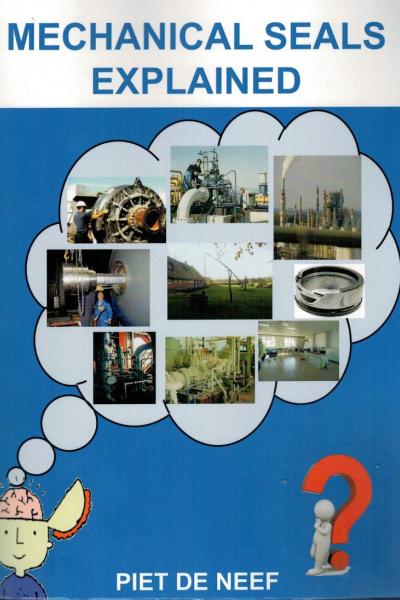
Mechanical Seals Explained
Mechanical Seals Explained by Piet de Neef is an in-depth technical reference work on the functioning, design, and application of mechanical seals in rotating machinery. The book combines fundamental theory with practical experience and covers both the physics behind sealing technology and the impact of machine design, process conditions, and installation quality on seal performance.
From sealing principles and pump configurations to seal design, API piping plans, installation, overhaul, and troubleshooting, each topic is developed in a systematic and technically substantiated manner. Numerous practical cases demonstrate that seal failures are often the result of broader system interactions rather than the seal itself.
This makes Mechanical Seals Explained an essential reference for maintenance and reliability professionals who aim to structurally improve seal reliability.
In Mechanical Seals Explained, Piet de Neef guides the reader step by step through the complete lifecycle of mechanical seals, from fundamental principles to complex real-world challenges. The book is structured as a coherent technical framework in which theory, design decisions, and practical experience are continuously interconnected.
After an introductory chapter covering the historical development and fundamental function of mechanical seals, various sealing methods for rotating machinery are compared. This clarifies why and when mechanical seals are preferred over alternative solutions such as packing seals or sealless systems.
The book then provides an in-depth discussion of pumps and other rotating equipment, with particular attention to seal chamber design, pressure relationships, and the influence of machine configuration on seal behavior. This forms the foundation for a detailed explanation of the operating principles of mechanical seals, including pressure distribution across the seal faces, deformation, lubrication, hydrodynamic lift, and the distinction between balanced and unbalanced seals.
Subsequently, the design and application of mechanical seals are addressed in detail. Topics such as spring configurations, material selection, single and double seals, tandem arrangements, and special applications (including high temperatures, slurries, low-emission requirements, and gas seals) are discussed with solid technical substantiation. International guidelines, including API 682 and associated piping plans, are also given prominent attention.
A significant part of the book is dedicated to installation preparation, assembly, and overhaul. Particular emphasis is placed on measurements, tolerances, alignment, setting, and commissioning, with the objective of preventing premature seal failures. Finally, the book includes comprehensive chapters on troubleshooting, supported by numerous practical case studies and structured tools such as checklists, reference tables, and a glossary.
Through this combination of technical depth, practical experience, and systematic structure, Mechanical Seals Explained is not only a textbook but above all a technical reference for professionals seeking to sustainably improve seal reliability, MTBR, and installation performance.

Piet de Neef began his career as a service technician with the Scottish pump manufacturer Weir Pumps at their Rotterdam branch, where he worked for nine years, interrupted by 21 months of military service.
In 1972, he joined what was then known as Borg Warner Mechanical Seals (now Flowserve) as a service engineer. Due to rapid turnover growth and increasing demand for technical support, he was asked in 1978 to establish a Service Department for the Eastern Hemisphere.
Alongside his role as Service Manager, he was once asked by a Sales Manager to deliver a training course for maintenance personnel at a refinery. Following that initial session (which lasted approximately 2½ hours), he independently developed a comprehensive two-day training program, including full course material. He has since delivered this course more than 800 times to over 200 end users in 32 countries.
Piet has over 40 years of hands-on industrial experience, during which he encountered and resolved numerous complex technical problems. His no-nonsense approach, combined with in-depth product knowledge and a strong understanding of operating conditions, maintenance practices, and human factors affecting mechanical seal performance, enabled him to consistently identify root causes beyond symptoms and assumptions.
In addition to his Dutch-language course book, Piet is the author of an extensive and highly practice-oriented English reference work covering all aspects of mechanical seals. The book is based on decades of experience and hundreds of professional interactions across industries where rotating equipment is used.
As a trainer, his style is clear, analytical, pragmatic, and occasionally enriched with subtle humor, always focused on strengthening the technical expertise of maintenance and reliability professionals.
BEMAS Corporate Sponsors