Why Predictive Maintenance Can’t Always Work
Predictive Maintenance and Condition-Based Maintenance are often presented as the most advanced forms of maintenance strategy. Compared with run-to-failure approaches or fixed-interval preventive maintenance, they promise a more targeted way of working: monitor the actual condition of an asset, detect accumulating damage, and intervene only when maintenance is needed.
In principle, this is a compelling approach. It can reduce unnecessary interventions, support better planning, and help maintenance teams focus resources where they create the most value. In practice, however, Predictive Maintenance and Condition-Based Maintenance do not always deliver the expected improvements in reliability, availability or uptime. In some cases, organisations invest in more sophisticated maintenance approaches only to see limited results, or even a decline in asset performance.
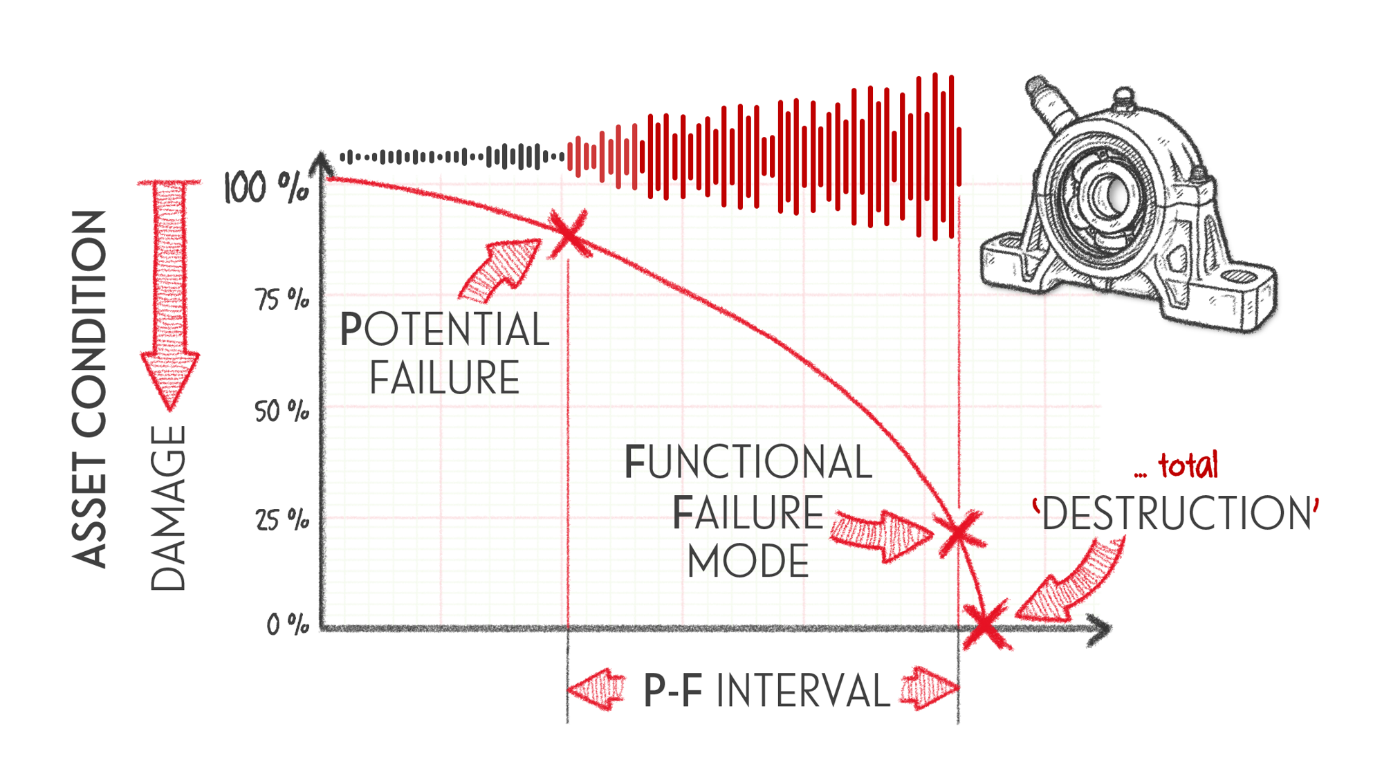
One of the reasons is that not every failure process can be predicted effectively. The usefulness of condition monitoring depends on the nature of the damage mechanism, the behaviour of the P-F interval, the randomness of failure, and the practical and regulatory context in which maintenance decisions are made. Without this understanding, organisations may end up “furiously fixing the wrong problem” and unintentionally creating new ones.
This webinar explores where Predictive Maintenance and Condition-Based Maintenance can go wrong. It provides a clear framework for understanding when these approaches are suitable, when they are not, and what asset owners, maintenance managers and reliability professionals should consider before relying on them.
Content of the webinar
- The origins of Reliability Centered Maintenance
- Introduction to the Nolan and Heap 1978 study
- How this study contributed to the development of Reliability Centered Maintenance
- Understanding the P-F Curve
- Explanation of potential failure and functional failure
- How the P-F Curve relates to asset condition and accumulated damage
- The importance of the P-F interval
- What the P-F interval means for interval-based monitoring
- Why inspection frequency and timing influence the effectiveness of PredM and CBM
- The randomness of failure
- Why seemingly identical components can fail at different times
- How random failure behaviour can limit the value of predictive approaches
- Impact on Predictive and Condition-Based Maintenance
- How P-F interval characteristics can jeopardise maintenance effectiveness
- How failure randomness affects the reliability of monitoring-based decisions
- Where PredM and CBM work well
- Scenarios in which predictive and condition-based strategies can deliver value
- Conditions that support successful implementation
- Legal and regulatory considerations
- Why certain frameworks may be needed to support effective use of PredM and CBM
- How compliance requirements can influence maintenance strategy
What you will learn
You will learn which characteristics of the P-F interval and the failure process can limit the effectiveness of Predictive Maintenance and Condition-Based Maintenance. The webinar also explains in which situations these approaches are most likely to work well, and which legal or regulatory conditions may be needed to support their success.
Join this webinar to gain a more realistic view of Predictive Maintenance and Condition-Based Maintenance, and to better understand when these strategies can genuinely improve reliability, availability and uptime.
Practical information
14:45 Welcome to the BEMAS Live Learning Platform
15:00 Start of the presentation
16:00 Conclusion and Q&A

About the speaker
Dr. Christopher Jackson, PhD, Director of Acuitas Ltd, is a reliability engineering specialist, leader and logistics expert with extensive experience in helping organisations improve the reliability of their products and processes.
Dr. Jackson completed his PhD in Reliability Engineering at the University of Maryland in 2011. He is the director of Acuitas Reliability and has supported organisations across a wide range of sectors, including medical devices, military vehicles, small satellites and health systems. After a 17-year career in the Australian Army, where he served as Senior Reliability Engineer and retired as a lieutenant colonel, he established the Center for the Safety and Reliability of Autonomous Systems at UCLA.
He is the author of multiple reliability and management textbooks and teaches both professional education and postgraduate courses. Dr. Jackson is a Certified Reliability Engineer through the American Society for Quality, a member of Engineers Australia and a Chartered Professional Engineer.
Keep me posted
BEMAS Corporate Sponsors