Reliable Bolted Joints in Practice based on VDI 2230 and VDI2231
Bolted joints are present in almost every industrial environment and are often considered straightforward components. In reality, insufficient attention to their correct application and maintenance can significantly undermine their long-term reliability.
Problems such as unexpected loosening, insufficient preload, fatigue failures, and inconsistent tightening results are common in practice. These issues are rarely caused by one single factor. In most cases, they result from the interaction between design, friction, load conditions, tightening methods, and actual in-service behavior. Without a sound understanding of these mechanisms, even well-intentioned actions such as lubrication or retightening can unintentionally increase the risk of failure.
At the same time, standards continue to evolve and performance expectations are becoming more demanding. Guidelines such as VDI 2230 Parts 1 and 2, the new VDI 2230 Part 3, and VDI 2231 for electrical bolted joints provide a structured framework for dimensioning, tightening accuracy, and specific applications. The practical interpretation of these guidelines, however, remains a challenge for many professionals involved in maintenance, reliability, and engineering.
This seminar brings together theoretical insights, field experience, and practical demonstrations to bridge that gap. Participants gain a clear understanding of preload behaviour, tightening accuracy, and self-loosening mechanisms, combined with concrete approaches to prevent failures. The focus lies on translating standards and theory into actionable practices that improve reliability and ensure durable bolted joints under real operating conditions.
« A bolted joint cannot be secured with a product alone, but requires a comprehensive understanding of tightening, load, vibration, and real in-service behavior. »
Programme of the seminar
1. Introduction
- Historical background
- State-of-the-art overview of bolted joints
2. Fundamentals
- Classification
- Thread types
- Thread parameters
3. Bolt dimensioning basics
- Spring model and joint diagram
- Load distribution and Functionality
4. Bolt dimensioning according to VDI 2230
- Main dimensioning principles: assembly preload, tightening factor, axial elasticity
- Importance and influence of preload
- Integration of results from FEA
5. Tightening
- Overview of tightening methods
- Accuracy and tightening factors according to VDI 2230 part 3 (draft)
- Influence of friction
- Work safety considerations
6. Self-loosening Mechanisms
- Embedding and relaxation effects
- Contact resistance in electrical bolted joints
- Self-rotation under dynamic loads
- Countermeasures and bolt locking elements
- Demonstration: Junker vibration test
7. Failure modes and Root Cause Analysis
- Durability verification according to VDI 2230
- Real-life failure examples
- Failure analysis methodology
- Countermeasures and prevention
- Corrosion and hydrogen embrittlement
8. Innovative solutions for bolted joints
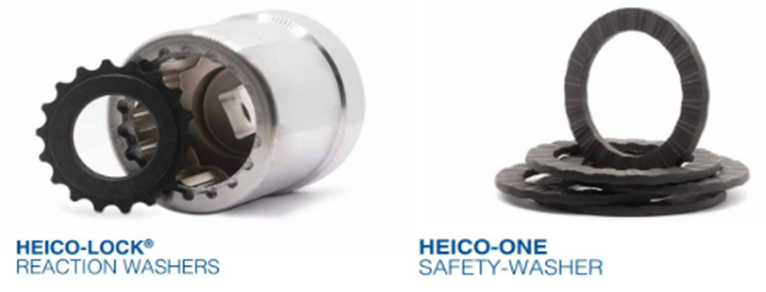
- Reaction Washer & One safety washer
- Combi Washer
- Reaction Nuts
9. Practical Demonstrations
- Mobile Junker vibration test and torque/preload measurement
- Tension nut tightening and reaction washer testing
- Bolt spring model visualization
Learning Takeaway
You learn how to correctly interpret preload, tightening methods, and failure mechanisms, and how to apply VDI guidelines in a practical maintenance context. You gain the insight needed to prevent common bolting issues and improve reliability and safety in your installations. Join this seminar to strengthen your expertise and translate theory into effective action on the field.
Live demonstrations with test equipment
See bolted joint behaviour in practice through a mobile Junker vibration test, torque-preload measurements, tightening tests, and real failure examples. These demonstrations make preload loss, self-loosening, and the effect of countermeasures directly visible and help translate theory into practical understanding.
Join this workshop to experience how bolted joints perform under real operating conditions.
Target Audience
This seminar is intended for professionals involved in the design, calculation, assembly, and maintenance of bolted joints, including:
- Engineers responsible for mechanical design and integrity
- Calculation engineers working on dimensioning and verification of bolted joints
- Maintenance and reliability engineers dealing with bolted joint failures and performance in the field
- Technical specialists involved in assembly, tightening, and inspection processes
The content is particularly relevant for those seeking a deeper understanding of bolted joint behavior, beyond basic theory, with a strong focus on practical application and failure prevention.
Please note: This seminar is designed for professionals whose work is directly related to the design, calculation, assembly, inspection, maintenance, or reliability of bolted joints. To ensure the content remains relevant and valuable for all participants, BEMAS and Heico reserve the right to review registrations and, where necessary, decline participation for individuals outside the intended target audience.

About the speaker
Tobias Hübing is Head of Laboratory at HEICO and specializes in the technical and scientific analysis of bolted joints. He supports complex engineering challenges, contributes to technical forums such as the VDI Bolt Forum, and regularly delivers advanced training sessions for international audiences. His expertise combines deep theoretical knowledge with extensive practical experience, making him well positioned to bridge the gap between standards and real-world applications.
Participation
- Free for employees who are a member of BEMAS
- Free for invitees of Heico
- € 85,- per person excl. VAT for non-members

Keep me posted
BEMAS Corporate Sponsors