All your failures could be caused by maintenance
Maintenance, inspections, servicing and overhauls are essential tools for improving reliability. You use them to remove damage before corrosion advances too far, fatigue cracks grow, lubricants degrade, or components reach a critical condition. In that sense, maintenance clearly supports asset performance, safety and availability.
At the same time, every maintenance intervention also introduces risk. Even when the work is carried out by skilled and experienced professionals, opening, adjusting, replacing, inspecting or reassembling a machine can unintentionally create new damage or failure opportunities. This phenomenon, known as the Waddington Effect, was first observed during World War II but is still rarely taught, studied or fully respected in today’s maintenance and reliability practice.
As an asset owner, maintenance manager or reliability professional, you may face situations where increasing failures lead to a natural response: adding more preventive maintenance, more inspections or shorter service intervals. But when maintenance itself contributes to failures, this response can reinforce the problem. The result can be over-maintenance: more downtime, more cost, more interventions and, in some cases, less reliability.
This webinar explores how maintenance-induced failures can be recognised, understood and addressed. By looking at historical and contemporary examples, statistical patterns and practical implications, you gain insight into how awareness of the Waddington Effect can help you move towards better targeted maintenance, improved availability and more effective reliability decisions.
Content of the webinar
- The historical discovery of the Waddington Effect
- Review of the maintenance optimisation of the British Air Force’s Bomber Command during World War II
- Explanation of how maintenance-induced failures were first identified
- How less, but better targeted, maintenance improved availability
- How doing less maintenance in the right way improved aircraft availability
- What this means for modern maintenance optimisation
- The statistical fingerprint of maintenance-induced failure
- How maintenance-related failures can appear in reliability data
- What patterns may indicate that interventions themselves are contributing to failures
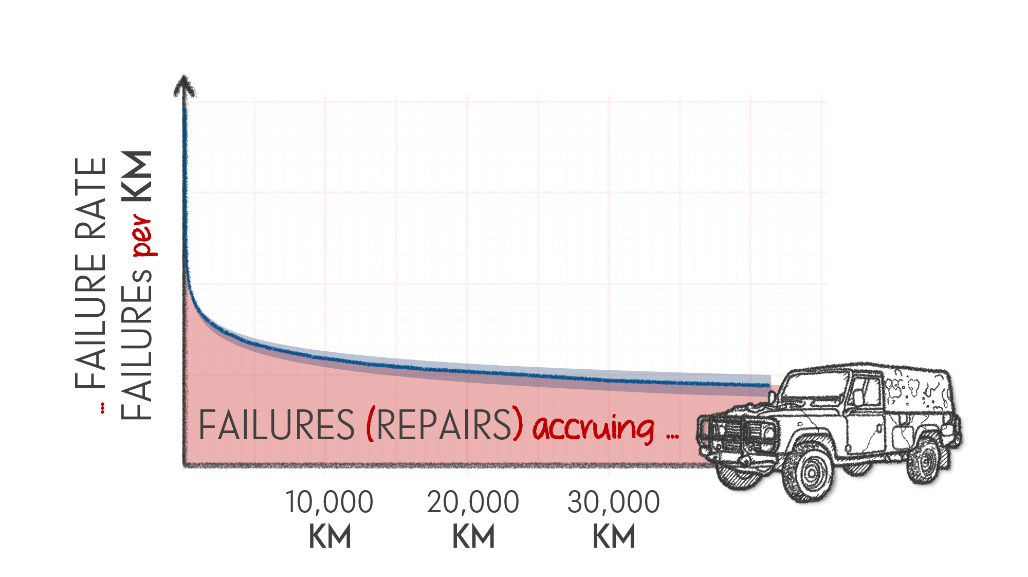
- Contemporary case study: Australian Army Land Rover 110 servicing intervals
- How this case replicates the Waddington Effect
- What can be learned from servicing interval data
- Why the topic remains underrepresented
- Discussion of the limited literature on maintenance-induced failure
- Reflection on the reliability, availability and cost implications of recognising the phenomenon
- Using statistical analysis to optimise servicing intervals
- Overview of relevant statistical approaches, including non-homogeneous Poisson process analysis
- How data can support decisions on when maintenance is needed, and when it may be excessive
What you will learn
You learn how maintenance can introduce damage, even when performed by competent personnel and according to established procedures. You also gain insight into how over-maintenance can become so embedded in asset management practices that it may account for a significant share of failures in certain systems.
The webinar will help you reflect on how maintenance can be better targeted to specific failure mechanisms, focusing on the vital few issues and applying interventions only as frequently as needed. Join this webinar to challenge conventional assumptions about preventive maintenance and explore how better maintenance decisions can support reliability, availability and uptime.
Practical information
14:45 Welcome to the BEMAS Live Learning Platform
15:00 Start of the presentation
16:00 Conclusion and Q&A

About the speaker
Dr. Christopher Jackson, PhD, Director of Acuitas Ltd, is a reliability engineering specialist, leader and logistics expert with extensive experience in helping organisations improve the reliability of their products and processes.
Dr. Jackson completed his PhD in Reliability Engineering at the University of Maryland in 2011. He is the director of Acuitas Reliability and has supported organisations across a wide range of sectors, including medical devices, military vehicles, small satellites and health systems. After a 17-year career in the Australian Army, where he served as Senior Reliability Engineer and retired as a lieutenant colonel, he established the Center for the Safety and Reliability of Autonomous Systems at UCLA.
He is the author of multiple reliability and management textbooks and teaches both professional education and postgraduate courses. Dr. Jackson is a Certified Reliability Engineer through the American Society for Quality, a member of Engineers Australia and a Chartered Professional Engineer.
Keep me posted
BEMAS Corporate Sponsors