How to Build Your Virtual Maintenance Engineer for Root Cause Analysis
Learn how to turn today’s AI capabilities into practical maintenance support and how to evolve from simple GPT to context-aware assistants and autonomous agents.
- Spend less time searching for RCA data.
- Turn fragmented maintenance data into useful context.
- Use AI to accelerate investigations, not to replace engineering judgement.
Root cause analysis is essential for improving reliability, but much of your investigation time can disappear before the actual analysis even starts. When information is spread across historians, ERP and CMMS systems, spreadsheets, manuals, logs and work notes, you first need to find the right data, align timestamps, reconstruct event sequences and verify alarms or interventions.
For a maintenance team, this creates a difficult balance. You want to investigate failures quickly while the event is still fresh, but you also need conclusions that are traceable, repeatable and based on the right operational context. Experienced engineers can therefore spend a significant part of their RCA effort gathering and reconciling information rather than analysing why the failure occurred.
Artificial intelligence can help with some of this work, but implementing it effectively requires more than connecting an AI model to your maintenance data. The system needs access to the right information, an understanding of the physical context in which your assets operate and clear boundaries for how its conclusions are generated and used.
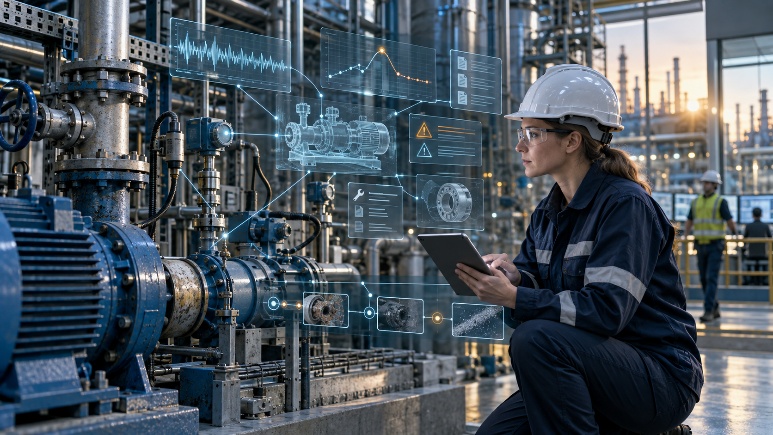
During this webinar, you explore what a Virtual Maintenance Engineer can realistically do today, where its limitations lie and how you can develop the concept step by step. Rather than treating AI as a black box that produces answers, you learn how it can become a reasoning partner that supports data gathering and investigation, allowing your engineers to concentrate on understanding failure mechanisms and defining appropriate actions.
Content of the webinar
Can AI actually take over maintenance work?
- What current AI technology can and cannot do in an industrial maintenance environment
- Where human engineering knowledge remains essential
- Examples of tasks that can already be supported by AI
The three challenges between your maintenance organisation and AI
- Making the required operational and maintenance data available
- Giving AI sufficient context to understand the physical reality of your assets and processes
- Combining information from different sources such as manuals, logs, CMMS systems and operational data
A practical playbook to start and scale
- Level 1 – Using GPTs: working with manual input to explore initial use cases
- Level 2 – Building a virtual assistant: connecting a chatbot with relevant data and context
- Level 3 – Moving towards an agent: exploring more autonomous execution of maintenance-related tasks
What will you learn?
You learn how to start or further develop AI initiatives within maintenance, what conditions are required for a useful Virtual Maintenance Engineer and which questions to ask when evaluating possible solutions and vendors. You also gain a practical framework for progressing from manually assisted AI towards more integrated and autonomous applications.
Practical Information
14:45 Welcome to the BEMAS Live Learning Platform
15:00 Start of the presentation
16:00 Conclusion and Q&A

About the speakers
David Ariens – Co-founder, The IT/OT Insider; co-author of The IT/OT Handbook
David Ariens is a mathematical engineer with a background in data science, industrial cybersecurity and industrial digitalisation. He started his career at BASF, where he worked on industrial cybersecurity and Industry 4.0 initiatives and ultimately led industrial digitalisation teams at the Antwerp site. He later managed Analytics for Industry, an Industrial DataOps specialist. Together with Willem van Lammeren, he founded The IT/OT Insider in 2023, focusing on practical knowledge about IT/OT, industrial data and digital transformation.

Willem van Lammeren – Co-founder, The IT/OT Insider; co-author of The IT/OT Handbook
Willem van Lammeren holds a master’s degree in Chemical Engineering from KU Leuven and has experience spanning production, operational technology and enterprise IT. His career has included roles at Barry Callebaut, AB InBev and BASF, where he worked across areas including logistics, laboratories, production, IT infrastructure, ERP and middleware. He currently serves as Delivery Manager at Syensqo, where he is involved in the development of the company’s operational data lake. Together with David Ariens, he founded The IT/OT Insider in 2023.
About The IT/OT Handbook
David Ariens and Willem van Lammeren are the authors of The IT/OT Handbook, a practical guide to bridging the gap between Information Technology (IT) and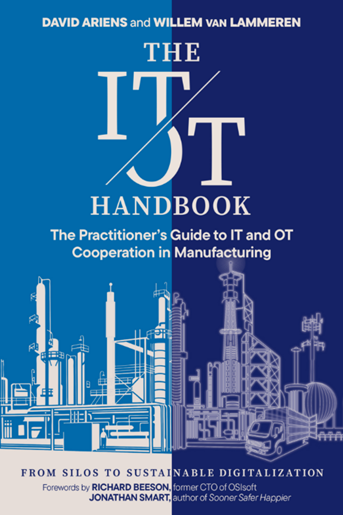 Operational Technology (OT) in manufacturing, the process industry and critical infrastructure.
Based on two years of research, conversations with industry practitioners and the authors’ own experience in industrial digitalisation, the book addresses the technical as well as organisational challenges behind IT/OT convergence. It is structured around three steps: Understand, Cooperate and Scale. These cover the differences between IT and OT, effective cooperation models, and the data, context and organisational foundations needed to scale digitalisation initiatives successfully.
The book is published by IT Revolution Press and is scheduled for publication in October 2026, in paperback, ebook and audiobook formats.
How to order:
The book can currently be pre-ordered through several international and European booksellers. For readers in Belgium and the Netherlands, options include Amazon Belgium, Amazon Netherlands and bol.com. Other European and international ordering options are also available.
Keep me posted
BEMAS Corporate Sponsors